
Budapest First-Time Travel Guide

The first time I came to Budapest was in mid – January, arriving by train from Prague. The train station, late evening, not a single streetlight on, and a biting wind with snow outside. Right by the entrance, Gypsies – looking like they stepped straight out of a Kusturica film – were roasting chestnuts in an overturned barrel. The metro, homeless people sleeping along the walls. My first thought was to grab a ticket for the night train and get the hell out of this Hungary back to warm and cozy Czechia.
But first, goulash. And then came the nighttime bridges, the Danube, the incredible Parliament building. Naturally, there was a second, third, and tenth trip to the Hungarian capital after that. Simply because that’s just how Budapest is – you can’t help but fall in love with it. It’s not as polished as Vienna, a bit more modest than Prague, but it’s bold and alive. You can come for a weekend, a week, or even just as a transit stop. There’s always somewhere to walk and have a good time.
This post isn’t about detailed descriptions of the sights. I’m not going to spend today rewriting Wikipedia or re-hashing guidebooks. This will be more about practical info for those who’ve decided to visit Budapest for the first time.

Formalities
The official language is Hungarian. And it’s a total nightmare. I can’t remember a single word for the life of me. Even the Albanian “faleminderit” stuck in my head right away. But here – absolutely nothing.
In case you need it:
Hello — szia (see-ya), Thank you — köszönöm (kuh-suh-num), Yes — igen (ee-gen), No — nem (nem).
Getting there
The Hungarian low-cost carrier WizzAir and, of course, Ryanair fly to Budapest from many European cities. You can stop in Budapest for a few days and then fly somewhere else.
The most convenient way to get from Budapest Airport is by express bus. Half an hour and you’re in the city center.

Money
Hungary is in the EU, but they have their own currency – the Hungarian Forint (HUF). There are banknotes in denominations of 200, 500, 1,000, 2,000, 5,000, 10,000, and 20,000. And coins: 5, 10, 20, 50, 100, 200. The fractional units – fillérs – haven’t been used since 1999.
In most places (90%), you can pay by card. But it’s better to have some small cash in forints or euros in your pocket. Small shops won’t let you use a card for minor purchases under ~€10. You won’t be able to buy a bottle of water. You can’t get into public toilets without coins. Plus, not all bars accept cards; it’s better to ask before ordering. In a pinch, you can pay in euros, but they’ll give you change at a very shitty exchange rate.
I have no idea where the exchange offices are or how to swap cash. I always just withdraw from an ATM. A word of warning – Budapest is crawling with ATMs from the predatory Euronet network, and the very first one you see at the airport exit belongs to them. Stay far away from those. You can buy your airport bus ticket at a machine using a card. Once you’re in the city, just withdraw money from an ATM of any local bank – like OTP or Erste.

About Safety
Budapest is a city for the youth. With cheap flights from all European capitals, the prices for food, alcohol, and entertainment are much lower than in, say, Paris or London. Many people fly in for the weekend to party and unwind. In the evenings, you’ll see some tipsy and noisy crowds, but it’s all in good fun and friendly. I’ve never felt sketched out walking through all sorts of different neighborhoods.
The only thing that might bug you are the homeless people in the underpasses, but after a day, you stop noticing them. Unless you decide to go scouting the outskirts of Budapest’s residential suburbs with the Gypsies, the city is safe to wander around.
Public Transport
Bus, tram, metro, and taxi – that’s what you’ll be using.
There is no Uber in Budapest. There are alternatives – Fotaxi and Bolt. The first one is the local Budapest city taxi. Bolt works in many European countries; I’ve used it all over the place. Install the app in advance, just so you have it.
To find out how to get where you need to go by bus or metro, use Google Maps. It’ll show you the nearest stop, which bus to take, how many stops until you need to get off, and how often the transport runs. Don’t forget to specify your departure time. This might be a “Captain Obvious” tip, but many people still don’t use this. Also, download the app beforehand.
You need to buy tickets from the machines. They aren’t at every single bus stop, but they are at most metro stations. I’ve explained how to buy tickets in detail – with pictures – in the article about getting from the airport. Or better use BudapestGo app (how to use it).
There are no conductors on the buses. There are no turnstiles in the metro. But there are ticket inspectors. They are mean, and the fines are huge. So even if you only need to go one stop – make sure you buy a ticket! Single tickets must be validated (time-stamped) before your trip – just stick it into the special device. In the metro, validators are located at the station entrance; on trams and buses, they are inside the vehicle. Without validation, your ride is considered unpaid.

Where to stay
Budapest is situated on both banks of the Danube.
Buda is where you’ll find the Buda Castle, Fisherman’s Bastion, the Rudas and Gellert baths, hilltop viewpoints, and beautiful vistas of the Hungarian Parliament from every angle. It’s better not to stay here. All of Buda is on a hill, and there aren’t many restaurants or cafes. You should live on the other side.
Pest is where all the main historical sights, the parliament, bars, and restaurants are located.
I recommend staying in one of these three districts in Pest:
- Belváros. If you stay here, you’ll rarely use public transport because everything is nearby. Here you’ll find:
- posh 5* hotels located right on the embankment with stunning night views: Marriott, InterContinental, Four Seasons;
- if you don’t care much about the view — the 4* Eurostars Center. We’ve stayed here several times; they have good discounts during the low season;
- lots of different accommodation options, including hostels and apartments, but they’ll all be a bit pricier due to the central location. It’s beautiful and safe. Use the hotels I mentioned as landmarks and pick anything nearby that fits your budget — the location will be great regardless.
- Erzsébetváros. The former Jewish Quarter. This is where all the bars — including ruin bars — restaurants, and clubs are. Accommodation is cheaper. It’s perfectly fine for exploring Budapest — the streets with the main sights are 1 – 2 km away, reachable on foot or a few metro stops. In this area, I like the Continental and Eurostars Danube.
- Terézváros. Borders Erzsébetváros. A good neighborhood, also central, comfortable, and safe. This is Andrássy Avenue and the Opera. Great for a first trip. If you need an inexpensive hotel 100 meters from the metro — Silver Hotel. The rooms are basic; some are large, some are tiny. It’s just luck of the draw. There’s no view to speak of. But it’s central, near the metro, and cheap.
Last time, we stayed at the Atrium Hotel. It’s a bit further out than these three districts, but it’s right by the metro and easy to get to. They serve unlimited champagne for breakfast there.

Where and what to eat and drink in Budapest
Goulash. Wine. Beer. Generally, all the dishes aren’t that different from the food we’re used to – meat, potatoes, vegetables. By the way, the Czech trdelník is called kürtőskalács in Hungary.
Goulash is made differently everywhere. Sometimes it’s very thick, and sometimes it’s almost like a soup. The spice levels vary. For me, the best one was that very first goulash I ever had. But no matter how hard we tried, we could never remember exactly where that was. Prices in city center restaurants range from 1,000 – 1,800 HUF (€2 – 5.5). Those promotional signs advertising goulash for 600 forints – that’s a half-portion. A main course averages 2,500 – 4,500 HUF, and one is usually enough to split between two people.
If you need a cheap lunch during the day, many places offer a “Daily Menu” business lunch. It’s a set meal at a fixed price from 12:00 to 14:00. It consists of two courses and a dessert for about 2,000 – 2,500 HUF.
You can fill up even cheaper with a döner (it’s a gyro if you’re Greek). Just 900 HUF and you’re full for the whole day (or night). If you wash it down with some ayran right there, food honestly doesn’t get any better. It’s sold everywhere. No need to look for special spots – just hop in line at any of them.
We usually grab wine at the store. The local wines are actually very decent. Prices start from 650 HUF for a bottle in shops and from 300 HUF for a glass in a restaurant. For beer, they have local, Czech, and German options. In bars, expect to pay from 600 HUF for a mug of the local stuff.
Heads up! Restaurants very often include a 10 – 15% service charge in the bill. This is written in the menu (usually in fine print at the end) and you can’t opt out. I’m warning you now so you don’t accidentally leave a tip on top of that.
For reasonable prices and good food, I recommend these few restaurants in central Budapest (Google Maps links):
- Tüköry Étterem – very popular with locals at lunchtime; the main course portions are huge.
- Right next to it is Kispiac Bisztro, a small, homey restaurant – it’s usually packed, but you might get lucky.
- Belvárosi Lugas Restaurant – very heartwarming service and excellent goose liver.
- Trófea Grill – you need to go here VERY hungry. You pay a fixed price and the buffet is all yours. Food and alcoholic drinks (wine, beer, champagne) – it’s all-inclusive. The price depends on the day of the week. Check their website for current rates. It’s better to book a table for Friday nights and weekends.
- Comme Chez Soi – Budapest is worth visiting just to try the foie gras at this restaurant. It’s tiny and incredibly popular; getting in without a reservation is practically impossible.


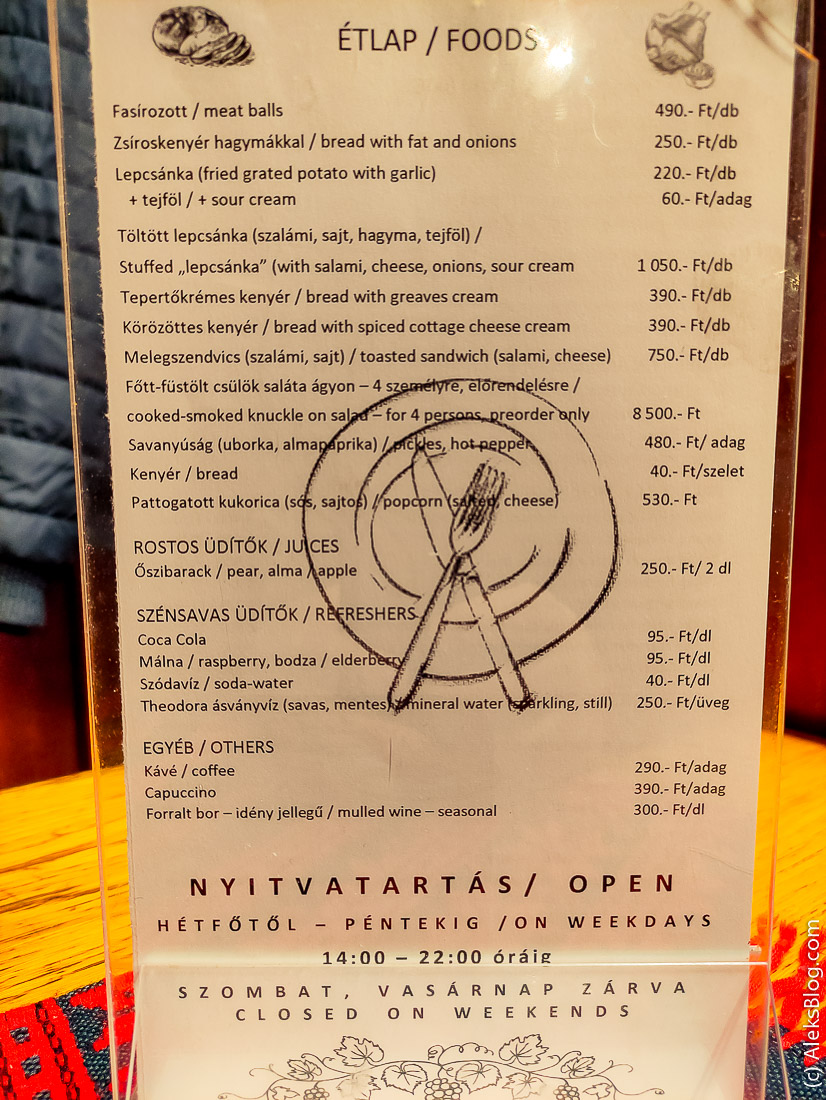
Tokaji Borozó – a little wine cellar, open from 2 PM to 10 PM. It’s a small, cozy “watering hole” serving Tokaj wines. It used to be locals only, especially in the evenings when it would get packed. The staff doesn’t speak English, and the menu used to be strictly Hungarian. Lately, various bloggers have been hyping it up (my bad) as an “authentic” spot. As a result, tourists drop in during the day, and an English menu has appeared. This place isn’t about a full meal. People come here to grab a glass and snack on a potato pancake or something similar. The prices are a joke – a glass of wine is 360 HUF (one euro). The menu lists 180 HUF for 100 grams – half a glass – but who actually orders that? Don’t embarrass yourself; just get the full glass.
Hrabal Pub – I discovered this one fairly recently. If you’re suddenly craving something Czech, head straight here. Beer, hermelín – everything you need for a pleasant evening. Connoisseurs of the finer things will appreciate it. The atmosphere is pure Prague.
New York Café, the “most beautiful cafe in the world.” Everything is expensive and very beautiful. Coffee is €8 and a small dessert is €10. It’s all about the interiors here, not the food. It’s basically like eating in Versailles. I don’t know anyone who actually has lunch or dinner there. Coffee and photos of the decor – yes; everything else – no.
In the evening, pick any spot in the Erzsébetváros district. Use the Great Synagogue as your landmark. One of my top recommendations is Gozsdu Udvar. It’s a small street that’s basically one giant food court. A huge selection of restaurants with every kind of cuisine. I personally like the Thai street food there – sorry about that. And sorry that some people think it’s a bit “mainstream.” But it really is cool. There are regular bars and clubs, too. Noisy, fun, and you can spend the whole night hopping from one place to another. There’s nothing to do there during the day.

Ruin Bars
Twenty years ago, the Erzsébetváros Jewish Quarter was in a truly pathetic state. During World War II, this once-prosperous neighborhood became a ghetto, from which tens of thousands of Jews were deported. After the war, the empty, ruined houses were occupied by Gypsies, who lived there until the 1990s. In the early 2000s, the boarded-up, soot-covered, filthy buildings were a total eyesore for the locals. The municipality had no clue what to do with them, and there were zero funds for reconstruction.
That’s when a couple of students took over a two – story house on Kazinczy Street. They dragged in furniture from old apartments, found decor in nearby dumpsters, and started pouring beer for their friends. They named the place Szimpla – Hungarian for “simple.” It was all about the vibe of a crumbling building, graffiti on the walls, and a free-spirited atmosphere. Every local started flocking to Szimpla. Within a few years, several more ruin bars opened nearby. Eventually, the authorities decided to start restoration work and announced they were closing Szimpla and tearing the building down. Naturally, the Hungarians immediately let them know that wasn’t going to happen, and after several protests, it was decided to keep the ruin bars as yet another Budapest landmark. And that’s awesome.
There are several active ruin bars. Here’s an overview of the ruin bars I recommend visiting.
Szimpla Kert (Google Maps link) – a must – visit, ideally in the evening. There’s security and a bag check at the entrance. Many people go inside just to wander around, take photos, or grab one beer and head out. It’s a strange and interesting spot, but there are plenty of other bars nearby, and Gozsdu Udvar is practically right around the corner.


Budapest Baths
This is a topic for a separate post. But in short, there are five baths, and each one is worth a visit.
Széchenyi – the largest bath, a signature landmark, and one of the postcard views of Budapest. This is the place with the massive open – air pool. Built in 1913, it features 18 outdoor and indoor pools and 14 different saunas. The water for the baths is sourced from a depth of 1,246 meters and has a temperature of 76 degrees Celsius – they actually have to cool it down before filling the pools. Opening hours: daily from 6 AM to 10 PM. Sheets, towels, slippers, and robes are available for rent. Take the first metro line to the Széchenyi fürdő station. Detailed info on prices and online tickets can be found here.
Gellért – the most luxurious bath, with Art Nouveau interiors. Fewer thermal pools, but more beauty. Open from 6 AM to 8 PM. Metro station: Szent Gellért tér. Website: gellertbath.hu
Rudas – has everything the others do, plus a rooftop jacuzzi pool with a view of the Danube and Elizabeth Bridge. This bath has men-only, women-only, and co-ed days. Co-ed days are Saturday and Sunday; women’s day is Tuesday; the rest are for men. It’s located near the Elizabeth Bridge on the Buda side. Opening hours: daily from 6 AM to 10 PM.
There are also Lukács and Király, but save those for another time.

City Routes
As I said at the beginning of the post, this is more about practical info, without the detailed descriptions, historical facts, or deep dives. But I’ve put together a two – day itinerary for you. If you’re short on time, you could squeeze it into one day, but it’ll be a “race against the clock” and you’ll have to skip the museums.
Day 1
You can spend your first day in Budapest exploring Pest.
Wake up early and head straight to Heroes’ Square, one of Budapest’s main landmarks. Right next to the square, you’ll find the Museum of Fine Arts and Vajdahunyad Castle. The castle is quite photogenic; you can walk around it, and if you’re already tired – take a break in the City Park. The Széchenyi baths are also nearby.
From there, without turning anywhere, walk straight down Andrássy Avenue and admire the local architecture. By the way, a short metro line runs right under the avenue – Line 1. Head down and check out the small stations, which have been preserved exactly as they were when they were first built.
Interesting spots on Andrássy Avenue:
- Oktogon Square, where the corners of all the buildings are clipped to form an octagon.
- House of Terror – located in the former headquarters of the Hungarian State Security Authority.
- The Opera House. Buy tickets in advance at opera.hu. It’s beautiful inside. You don’t have to wear a tuxedo or an evening gown, but maybe skip the sweatpants too. Jeans and a sweater are perfectly fine.
Walk until you reach St. Stephen’s Basilica. Opposite the basilica, there are two coffee shops – Starbucks and its twin, California Coffee Company. It’s become a bit of a habit for us to sit there for a coffee when it’s cold or something refreshing in the summer. Both cafes have restrooms with keypad locks. The code is printed on the receipt, but you can just ask the staff. If you’re too shy to ask, grab a receipt from one of the left-over trays on the tables.
St. Stephen’s Basilica is the largest church in Hungary, named after the country’s first king. It used to be free to enter. Now, tickets are 2,300 HUF, or 4,300 HUF if you include the panoramic terrace. The ticket office is in the building across the street, next to Starbucks. And, of course, there are queues. So, buy them online on the official website.
Note: the tickets sold right at the cathedral entrance are for evening organ music concerts.


Walk through Liberty Square toward the Parliament. If you’re in the mood, you can pop into the Museum of Ethnography to learn all about the origins of the Hungarian people. This museum didn’t really do it for me – but then again, I’m generally not a big fan of ethnography museums. I don’t know, maybe you’ll like it.
The Hungarian Parliament is an absolute knockout! You can spend hours just walking around it and taking it all in.
You can only get inside the Parliament on a guided tour as part of a group. It takes about 50 minutes. You need to buy tickets in advance.

Walk around the Parliament building and head to the embankment, where you’ll find the Holocaust memorial – Shoes on the Danube Bank. Near the end of World War II, mass executions of Jews took place in Budapest. To save bullets, the Nazis tied the victims’ hands and feet, lined them up on the riverbank, and shot the first person, who would fall and drag the rest into the water. It’s an incredibly emotional, heavy place.
Now, make your way toward Váci Street – the main tourist drag of the historical Belváros district. Plenty of boutiques, shops, cafes, and restaurants. Walk all the way to the end, and you’ll arrive at the Great Market Hall of Budapest.
The market is open daily except for Sundays. Hours: 06:00 – 18:00, Saturdays until 15:00, and Mondays until 17:00.
At the market, you can buy paprika (regular, spicy, or smoked) and then head up to the second floor to take a photo next to the restaurant with the erotic name – FakAnal.
I suggest watching the sunset at the awesome viewpoint near the Citadel on Gellért Hill. To get there, take a walk up from Elizabeth Bridge, and you can head back down toward Liberty Bridge.


Day 2
Today, I suggest exploring Buda, taking a boat ride on the Danube, and heading to the baths if you haven’t been yet.
It’s best to start your Buda walk at Fisherman’s Bastion. You can get there on buses 16, 16A, or 116. Like I said, Google will map out the public transport route from your hotel. Consider this homework – practice using Google Maps to find the bus stops.
You can also get to the Buda Castle by funicular (the boarding point is here), but a 2 – minute ride will cost you 4 euros. To me, that’s just throwing money away. Take the bus up, then walk back down toward the Chain Bridge or head over to the Citadel if you haven’t seen it yet.
Don’t let the fact that there are only three points on the map a kilometer apart fool you. The area is packed with sights, museums, and killer views of Pest.
Fisherman’s Bastion is a square in the Buda part of the city, with the St. Stephen monument at its center and a 140 – meter gallery featuring seven towers, symbolizing the seven tribes that founded the Hungarian state.
The bastion never actually served a defensive purpose. It was built in the early 20th century purely for aesthetics. Well, it turned out pretty beautiful, didn’t it? And it got the name “Fisherman’s” because, in the old days, there used to be a fish market on the square.


Next to the bastion is the Gothic Matthias Church. It was built in the 11th century, destroyed in the 13th, and rebuilt in that same century. Formally, it’s the Church of the Assumption of the Virgin Mary, but everyone calls it by the name of the Hungarian King Matthias Corvinus.
The Royal Palace now houses the Hungarian National Gallery and the Budapest History Museum. I highly recommend visiting the National Gallery. Even if you don’t go inside (which would be a total waste), wandering around the grounds is still interesting.
River Cruises on the Danube
If a city is built next to a river, you can bet there are boat tours. I don’t know about you, but I love this kind of thing.
In Budapest, these are mostly one – or two – hour routes: daytime sightseeing, evening cruises, or dinner cruises. Personally, I prefer this one, with unlimited prosecco, beer and aperol.


