
Tokyo, Osaka & Kyoto — Where I Stayed and What I Recommend

Koniciva!
The biggest pain in Japan is hotel and train prices. These are the two major expenses. That said, if you’ve already accepted that a dump in Barcelona costs €125, hotel rates in Japan won’t come as a huge shock.
In this post, I’ll share tried-and-true hotels in Tokyo, Osaka, and Kyoto, tell you how much we paid for rooms, and which neighborhoods are best to stay in. I know nothing about luxury places or hostels. When I travel, I stay in regular hotels — the main things are a clean room, a decent bed, and a good location.
Where to Book
I searched and compared prices on Booking, Agoda, and Trip.com. In the end, I booked all hotels through Trip, and one through Agoda.
For Asia destinations, Trip and Agoda definitely beat Booking in both price and the number of hotels connected to the booking system. Prices on Trip and Agoda are more or less the same, but sometimes you can catch a discount. Check prices on both Agoda and Trip and book wherever it’s cheaper. Both services are reliable.
For those who aren’t familiar:
- Trip – a Chinese booking service for hotels, flights, and train tickets worldwide. You can also buy entrance tickets to various attractions, tours, and activities in Japan and other countries.
- Agoda – part of the same group as Booking, but Agoda focuses on Asia. Their terms are better here than Booking’s.
I list prices in euros (it’s easier for me) at the time of booking, but of course – seasonal discounts and surcharges still apply.
Kyoto
Kyoto is by no means the “little village with geishas and samurais” from old movies — it’s a huge, modern city.
I’ve highlighted the main neighborhoods you need to know. I’ll cover Kyoto, Osaka, and Tokyo in separate posts, but for now, when choosing a hotel, use this map as a guide.
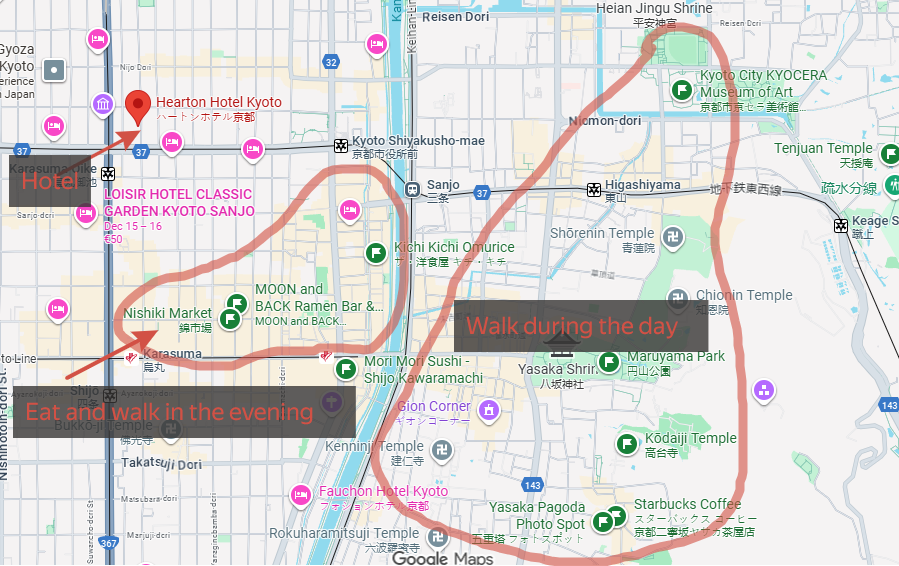
The first Japanese hotel we stayed at was Hearton Hotel Kyoto (€90 per night, link on Trip.com / Agoda). And it had the best room — the biggest one. Probably because we got lucky and were given a triple.
Breakfast wasn’t included, so we paid extra on site. You can have breakfast on the first floor — a buffet, or on the second floor — a Japanese-style breakfast. That’s when you sit at a small table and get served many small plates, each with a bit of everything. On the first floor it’s the same, even more, but you serve yourself. So yes, get breakfast, but go to the first floor.
You can’t smoke on the street near the hotel! In Japan, smoking is banned in public places. Even if no one is around. You can’t hide around a corner and quietly puff a cigarette. There are special fenced areas on the streets, very few, but they exist. Deal with it. At Hearton, on the second floor, there’s a special booth like in airports.
On the floor, there’s a vending machine, a washing machine, and a dryer. Payment is by coins. I don’t remember the exact price, but it’s cheap.
50 meters from the hotel is a 24-hour 7-Eleven. A five-minute walk brings you to Karasuma metro station — that’s 10 minutes to Kyoto Station, 40 minutes to Arashiyama, 30 minutes to Fushimi Inari. There’s also a bus stop nearby. No problems at all with “how to get to Kyoto’s main spots.” If I had to choose where to stay in Kyoto again, I’d pick this hotel or any nearby. The neighborhood is very nice.


Tokyo
Tokyo doesn’t have a historical center or a single district where all the main attractions are concentrated. They’re scattered across the city. If it’s your first time here, pick the key spots for yourself: Akihabara, Asakusa, Ginza, Shibuya, Shinjuku.
We stayed at Hotel Tavinos Asakusa (€95 per night, Trip.com / Agoda). The hotel is conveniently located: within walking distance (10–15 minutes) of several metro stations — Asakusa and Tawaramachi. Right across from the hotel is a bus stop. Getting here and back is easy — whether from the airports or Tokyo Station.
Everything you need to know about public transport in Japan.
The hotel itself is designed in a minimalist style — somewhere between Scandinavian simplicity and Japanese Zen. There are vending machines in the building, as well as laundry and drying machines. In the mornings, you can grab free coffee and muffins in the common area. But just around the corner is a 24-hour Lawson convenience store, where you can buy ready meals, have breakfast there, or bring it back to the hotel.
Now about the room. In my ranking, it was the smallest room I’ve ever stayed in. Before this, the record was held by a similar hotel in Copenhagen, but at least that one had a corridor. In Japan, tiny rooms are almost the norm: 10–12 m² is standard, and anything bigger is already “luxury.”
If you have a choice, take a room with separate beds. Otherwise, be ready to share a 140 cm bed, just a bit wider than a standard single-and-a-half.
To make it clearer, here’s what’s in the photo. Imagine: you open the door, step in, and immediately hit the bed. Between the entrance and the bathroom door there’s about 0.5 × 1.2 meters of space. That’s all the room you have to undress, open your suitcase, grab things, and slide your suitcase under the bed. Doing this as a pair is impossible; one person will have to lie on the bed or sit in the bathroom. There’s hardly anywhere to hang clothes — only three hangers.
The plus side — the view from the window, which is behind the curtain at the head of the bed.


The Asakusa neighborhood is just fantastic. There are a LOT of inexpensive, authentic cafés — the best in all of Tokyo. Finding a place to eat in Asakusa is no problem at all: there’s something for every budget, you just need to wander a bit away from the main street. Focus on the streets around Don Quijote Asakusa and nearby. In the evening, there are no crowds. No skyscrapers, and you can take a break from all the advertising signs. I really enjoyed staying in Asakusa. It’s a slightly old-fashioned Tokyo, especially nice in the evenings. And accommodation prices are reasonable.
Another good area, convenient for getting around Tokyo, is south of Asakusa — near Hamacho Station and Ningyocho Station. Hotels will be a bit more expensive, but getting to all the main spots is slightly faster (you save around 10–15 minutes). Hotel examples:
- APA Hotel Ningyocho Eki Higashi (€100–125 per night, Trip.com / Agoda)
- APA Hotel Ningyocho Eki Kita (€120 per night, Trip.com / Agoda)
Apa is a popular hotel chain aimed at Japanese business travelers: work, drink, come back, crash, sleep, shower, and head back to your prefecture.
And once again, the view from our room, day and night. Pure bliss. I love this.


Osaka
You should stay in the Dotonbori district — it’s the nightlife hub of Osaka. If you’re staying just a couple of days, this is the only place to be. All the evening action, restaurants, cafés, bars, entertainment, shopping — it’s all here. And even your favorite Uniqlo, if Tokyo hasn’t sold out everything. Missing trash on the streets and smoking whenever you want? Head to Dotonbori! During the day, it’s typical Japan, but once the evening lights turn on… I definitely recommend this neighborhood.
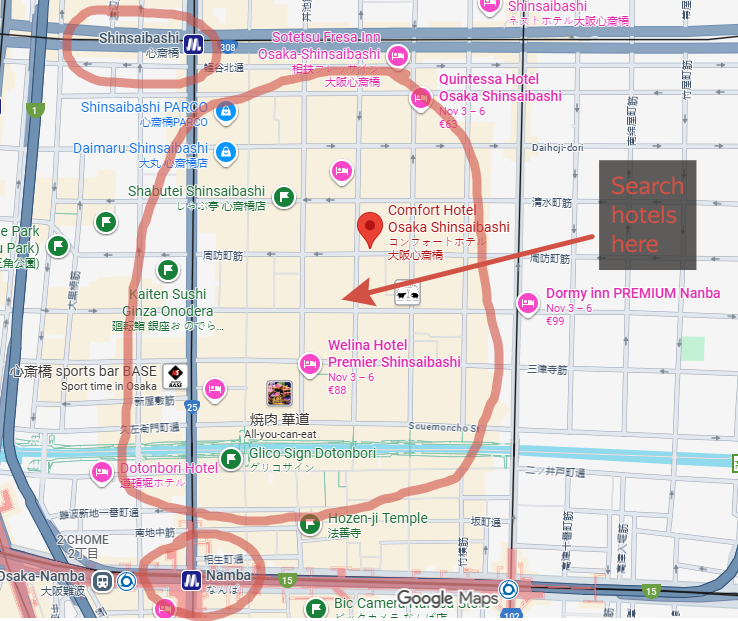
Comfort Hotel Osaka Shinsaibashi (€90, Trip.com / Agoda). Compared to the Tokyo hotel, this one has a simply huge room. The hotel itself couldn’t be better located. Two 24-hour stores are right next door — FamilyMart and Lawson. There’s a good breakfast. The metro is a 10-minute walk, with several stations — Shinsaibashi and Yotsubashi. Getting to Nara, the airport, or the main station is completely hassle-free.
No rooms here or don’t like it? Nearby options:
Anything in the area between these hotels and Namba Station is perfect in terms of location.


Where to Stay in Tokyo, Kyoto, and Osaka: A Quick Summary
Tokyo
- There’s no single center — attractions are scattered around the city.
- For a first visit, focus on: Asakusa (cozy, authentic, no skyscrapers, with the best restaurants) and the Ningyocho/Hamacho area (convenient for getting around the city, hotels a bit more expensive).
- For hotel chains, consider APA Hotels — simple, functional, with good locations.
Kyoto
- The city is large, with different neighborhoods, but it’s convenient to stay near Karasuma metro and in areas with easy access to Kyoto Station.
- The area around Hearton Hotel Kyoto is pleasant, quiet, and well connected, with good infrastructure (shops, buses, metro).
- Hearton Hotel Kyoto — reasonably sized rooms by Japanese standards and good breakfasts.
Osaka
- The best place for a short trip is Dotonbori. It’s the center of all nightlife, food, shopping, and entertainment.
- If you want to be “in the thick of things,” choose hotels between Shinsaibashi and Namba stations.
- Good options: Comfort Hotel Osaka Shinsaibashi, APA Hotel Namba Shinsaibashi Higashi, Candeo Namba.
