Driving Yellowstone

Continuing my series of posts about the trip along the US West Coast and national parks. So far it’s a bit unsystematic, but I’ll try to fix that.
The notes are mostly photographic, with a bit of useful information for anyone planning a trip.
So, it’s October, early in the morning we set off by car from Grand Teton toward Yellowstone. The US-191/US-89 highway leads straight to Yellowstone’s south entrance.
Yellowstone: where it is
Yellowstone National Park is located in the northwest of the USA, mostly in Wyoming, but it also covers parts of Montana and Idaho. The park spans about 9,000 km², making it one of the largest national parks in the US.
Actually, forget parks… Just imagine: Yellowstone is 12 times bigger than Singapore, and the park could fit 86 cities the size of Paris!
What it’s famous for
Yellowstone has the largest concentration of geothermal features on the planet — over 10,000 in total. Around 500 geysers, hot springs with temperatures from 40 to 90°C, mudpots, fumaroles — crater cracks, and travertine terraces. Everywhere you look, something is bubbling, gurgling, hissing, steaming, and in some spots, giving off a smell.
After Yellowstone, all other geysers and hot springs in your life will seem like a pale imitation of what you’ve seen here. When I stood in Iceland by the very Geysir that gave its name to this natural phenomenon, I kept thinking, “Wow, and all the hype about it…”


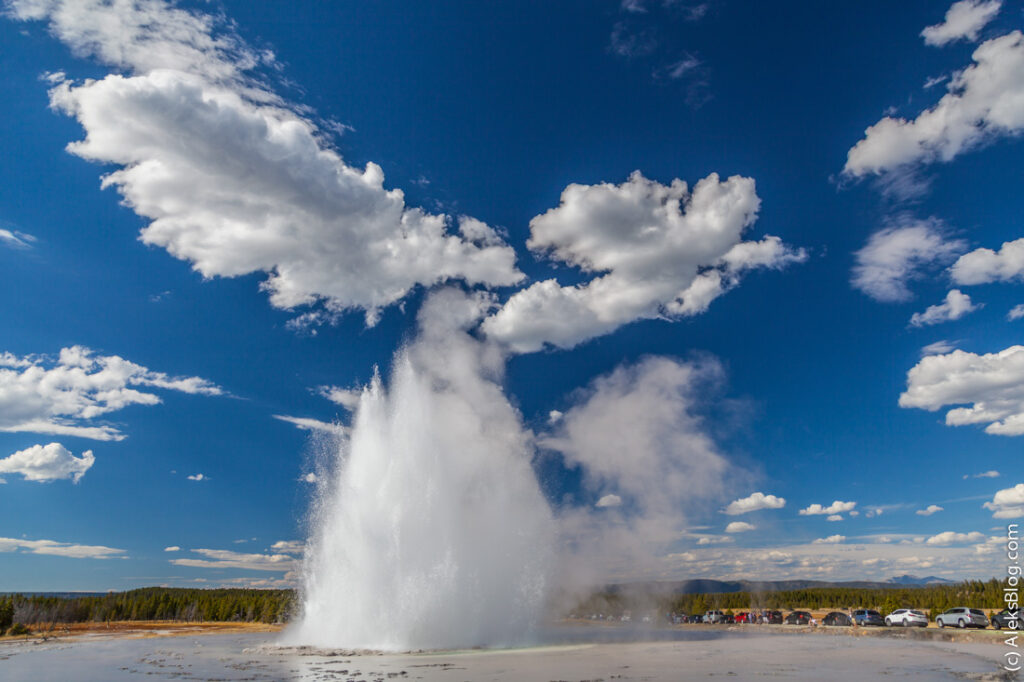
Old Faithful

How to get there
Nearest airports to Yellowstone National Park
-
Jackson Hole Airport (JAC) — about a 90-minute drive from the park’s south entrance. This is the most convenient airport for those planning to visit both Yellowstone and Grand Teton.
-
Bozeman Yellowstone International Airport (BZN) — roughly 1.5 hours’ drive from the park’s north entrance (in Gardiner).
-
Yellowstone Regional Airport (COD) in Cody, Wyoming — about a 1-hour drive from the east entrance.
-
Idaho Falls Regional Airport (IDA) — around 2 hours’ drive from the west entrance.
Naturally, you’ll need a car. If you haven’t rented one yet, the nearest airport rental options can be found on DiscoverCars.
Yellowstone Entrances
There are five main entrances:
-
North Entrance (45.0259° N, 110.7058° W) — Gardiner, Montana.
-
South Entrance (44.1523° N, 110.6751° W) — connects the park with Grand Teton National Park.
-
East Entrance (44.4887° N, 110.0022° W) — road from Cody, Wyoming.
-
West Entrance (44.6621° N, 111.1042° W) — West Yellowstone, Montana.
-
Northeast Entrance (45.0031° N, 109.8548° W).
Tours
For those who want to sit back and let someone else do everything for them.
Where to stay
Expensive, very expensive — in the hotels inside the park:
-
Old Faithful Inn — hotel near the geyser.
-
Lake Yellowstone Hotel — hotel with a view of Yellowstone Lake.
-
Canyon Lodge — conveniently located near the Grand Canyon of Yellowstone.
I didn’t even consider these options. You can look outside the park near the north entrance: Gardiner (for example, Travelodge or The Ridgeline Hotel), or better yet near the west entrance: West Yellowstone — we stayed two nights at City Center Motel. The motel’s price is definitely shocking, but it’s Yellowstone, baby, and super close to the park.
- check all accomodations in West Yellowstone
Can you camp in the park?
Yes, Yellowstone has several campgrounds where tents are allowed. The most popular campgrounds are Madison, Grant Village, and Bridge Bay. Campgrounds require advance booking, especially in the summer when visitor numbers peak. Detailed information is available on nps.gov.


What to see in Yellowstone
We spent two full days in the park, plus the day we arrived from the Tetons. That’s enough to see all the interesting spots without overdoing it. I could have stared at each colorful pool for ages.
I recommend an audio guide with a map for all the points in Yellowstone.
Keep in mind that traveling between points can take longer than Google Maps suggests, as traffic moves slowly and there can be jams caused by wildlife.
Fill up your tank before entering the park. Bring a couple of gallons of water and some food. Things are expensive inside the park.
Day 1: Exploring the Western and Central Parts of the Park
Norris Geyser Basin
Our first long stop was Norris Geyser Basin. This is the hottest and most dynamic geyser basin in the park. Steamboat Geyser, the world’s tallest active geyser, erupts up to 90 meters high.
Mammoth Hot Springs
Next, head north to Mammoth Hot Springs. Admire the vibrant terraces. You can walk along the wooden boardwalks and enjoy views of pools like Minerva Terrace and Palette Spring.
Lamar Valley
After visiting the hot springs, move east to Lamar Valley. This is one of the best spots in the park to see wildlife, not just bison.
Tower Fall
On the way back, stop at Tower Fall. This 40-meter waterfall is surrounded by picturesque peaks.
Day 2: Geysers and Lakes
Less driving, more walking and sightseeing.
Grand Prismatic Spring
Start the day with Grand Prismatic Spring in Midway Geyser Basin. This hot spring is the third largest in the world and famous for its vivid colors. Be sure to climb the observation hill nearby to see the spring from above.
Old Faithful
Next stop is the famous Old Faithful. This geyser erupts every 60–90 minutes. Don’t forget to check out Old Faithful Inn, one of the oldest wooden hotels in the US.
Upper Geyser Basin
Take a walk around Upper Geyser Basin, home to numerous geysers like Castle Geyser and Beehive Geyser. This area has the largest concentration of active geysers in the world.
Black Sand Basin and Biscuit Basin
Moving on, stop at Black Sand Basin and Biscuit Basin. These are less crowded spots, but you can still see colorful hot springs and fumaroles.
West Thumb Geyser Basin
Finish the day at West Thumb Geyser Basin on the shore of Yellowstone Lake. Here, the hot springs are right by the water, creating a stunning contrast.
Yellowstone Lake
Spend the rest of the evening enjoying views of Yellowstone Lake. It’s the largest high-altitude lake in North America, surrounded by mountains and forests.

Grand Prismatic Spring


Why hot springs are colorful
Hot springs get their vivid colors from various microorganisms that live in waters with different temperatures and chemical compositions.
These microorganisms can survive extreme temperatures and diverse chemical conditions. They form colorful mats around the springs. The color varies depending on the type of microorganisms and the water temperature. For example, yellow and orange hues are caused by bacteria like cyanobacteria, which contain carotenoids — pigments that protect them from ultraviolet light and produce these colors. And so on. It’s all microbial life, not just colorful rocks.
In addition, minerals and the chemical composition contribute to the color. For instance, high iron content in the water can create reddish tones.
Morning Glory Pool
I want to highlight one of the most famous hot springs in Yellowstone. Named for its shape, reminiscent of the morning glory flower, this spring impresses with its vivid, rich colors and unusual funnel-like form.
Interestingly, Morning Glory Pool used to be bright blue, but it has changed over the years. Tourists threw coins and trash into the spring, which clogged and narrowed it, lowering the water temperature. As a result, the bacterial composition shifted, leading to the appearance of yellow and orange hues.
In the 1950s, the spring became the focus of a conservation campaign once it became clear that human interference could alter such unique places.

Hot spring temperatures
The water temperature in Yellowstone’s hot springs can vary greatly depending on the specific spring and its location in the park.
The average water temperature in the springs is usually 40–70°C. This is the range in which various microorganisms can survive and thrive, creating yellow, orange, red, and green hues.
The hottest springs, such as those in Norris Geyser Basin, can reach temperatures above 90°C. For example, Boiling River has a temperature of around 88°C.


Mammoth Hot Springs
Imagine huge stepped terraces flowing down the slope, sparkling in shades from bright white to deep yellow and orange.
How was it formed?
It’s all due to the hot springs that erupt from underground in this area. The water rises from deep below and passes through limestone rocks. On the way up, it carries calcium, which, when it reaches the surface, precipitates to form the beautiful terraces. These deposits are called travertine.
This process is similar to what happens in caves with stalactites and stalagmites, but on the surface.
The Mammoth Hot Springs terraces are constantly changing. Some springs may dry up, while new terraces can form elsewhere. This happens because geothermal activity and the movement of underground water affect how water is distributed.
The water in Mammoth Hot Springs is around 70°C. The high temperature and mineral content create ideal conditions for forming travertine structures.
As for the colors, you already know—the same microorganisms are responsible.
In this area is the historic Mammoth settlement, one of the first bases for Yellowstone research. In the early 20th century, the military was stationed here to protect the park’s natural resources, and later it became the center for Yellowstone Park management.


Wildlife
Bison, bears, moose, deer, coyotes… Danger is everywhere. I don’t know how people aren’t afraid to sleep in tents.
How to spot animals? Bison are guaranteed — you’ll see them everywhere, grazing like cows in their home territory. But if you’re after something bigger, like a moose or deer, you need to keep watch and hope for luck.
Lamar Valley is the richest area for wildlife. It’s even called the “North American Serengeti.” The valley is home to the Big Five of Yellowstone — the five largest animals: bison, bear, elk, moose, and wolf. There are also large bison herds.
If you see a group of people with huge camera lenses pointed at something in the distance, quietly move closer and look the same way—they’ve probably spotted something amazing. This usually happens at dawn or dusk.


We’re moving on. Stay tuned, the next part is coming soon.