How to Use Public Transportation in Istanbul

Merhaba!
Every time I visit Istanbul, whether just passing through or strolling along the Bosphorus, I only use public transport. Despite the city’s massive size and the fact that it sits across multiple shores and continents, I consider Istanbul’s public transport network one of the clearest and most convenient in the world.
I’ll explain everything you need to know as simply as possible if you’re heading to Istanbul for the first time — from buying a transport card to which types of transport you’ll actually need.


What You Need to Use Transport in Istanbul
You’ll need:
- Istanbulkart — for paying fares.
- Internet access, to plan routes, check directions, travel time, and so on. Google Maps is a great app for this.
Get an eSIM in advance for internet in Turkey. You can get one from Yesim.
Istanbulkart
You can pay for fares with a Visa/Mastercard bank card. But that’s expensive. If you’re planning more than one or two trips in Istanbul, you need an Istanbulkart. It’s a standard transit card.
For example, a bus fare paid by bank card costs 100 lira, while with Istanbulkart it’s 42 lira.
You can buy an Istanbulkart at the yellow-and-blue Biletmatik machines. They’re located at every metro station, in the center near many major tram and bus stops, and at IST and SAW airports near the metro. You can top up the card at the same machines whenever needed.
Buying and topping up the card is very simple. The screen offers an English language option.
Tap the screen, select the language and “buy.” You can pay in lira or by card. The machine doesn’t give change — any remaining balance is credited to the card. To check your Istanbulkart balance, place it on the designated reader spot. If your balance is insufficient, select “top up” in the menu and pay with cash or a card.
While topping up, the card must stay on the reader the entire time! Some people place the card down, the machine reads it, and they immediately pick it up. No! Place it and don’t touch it.
Never let “helpers” near you. With a simple sleight of hand, they’ll swap your card for theirs, and you’ll end up topping up their Istanbulkart instead of your own.
I took photos specifically for you. It’s very straightforward.


Istanbulkart — What You Need to Know
To pay your fare, tap the card on the turnstile when entering the metro, at tram stops, and at the ferry pier. On buses, you board through the front door, with the terminal to the right of the entrance.
Up to five people can use a single Istanbulkart — you don’t necessarily need to buy a separate card for each person. Tap the card on the validator, the first person goes through. Pass the card to the next person, they tap it again, and so on up to five times. The full fare is deducted from the balance for each passenger.
An important detail — an unregistered Istanbulkart has a top-up limit, roughly 2,750 lira per month. That’s more than enough for a tourist, but if you travel a lot or share one card among several people, you might hit the limit.
It’s better to buy a card for each person. It’s not a huge expense, and you’ll avoid doing the math. Or just buy one once you hit the top-up ceiling.
Istanbulkart used to offer transfer discounts, but now that only applies to registered cards (for citizens and residents). If you have a regular tourist card, you pay the full fare for every trip.


How Much Fares Cost
Here are the 2026 prices, so you can roughly estimate how much to load onto your card the first time. Give or take.
| Transport type | Istanbulkart fare |
|---|---|
| Bus / Metro / Tram | 42,00 ₺ |
| Ferry (Eminönü — Üsküdar) | 53,20 ₺ |
| Ferry (Eminönü — Kadıköy) | 59,28 ₺ |
| Marmaray | 75,00 ₺ |
| Metrobüs | 48,00 ₺ |
A Quick Geography Lesson
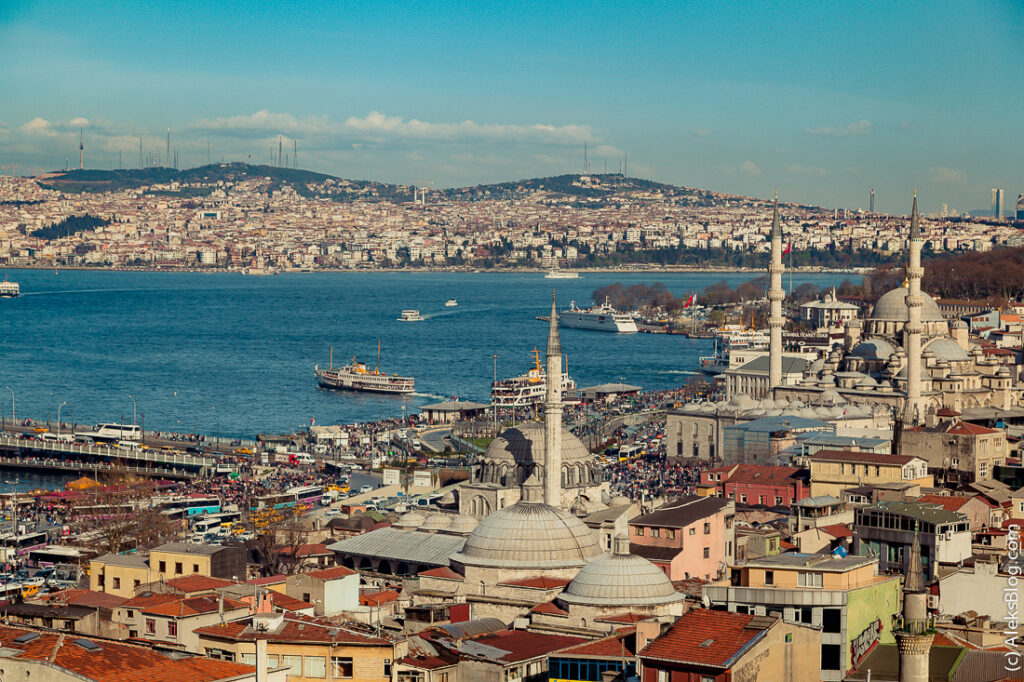
I’ll be mentioning some districts further on, so a bit of explanation is needed. This will also give you a rough sense of where the interesting places are, and where Europe ends and Asia begins in Istanbul. Most people mistakenly think the Galata Bridge divides the European and Asian sides.
Here’s a rough visual guide.

- Beyoğlu district — this is where Taksim, İstiklal Avenue, and Galata Tower are.
- Neighboring Beşiktaş — Dolmabahçe, Ortaköy Mosque.
- Karaköy — the waterfront part of Beyoğlu: the fish market, the promenade, Galataport, the Istanbul Modern museum.
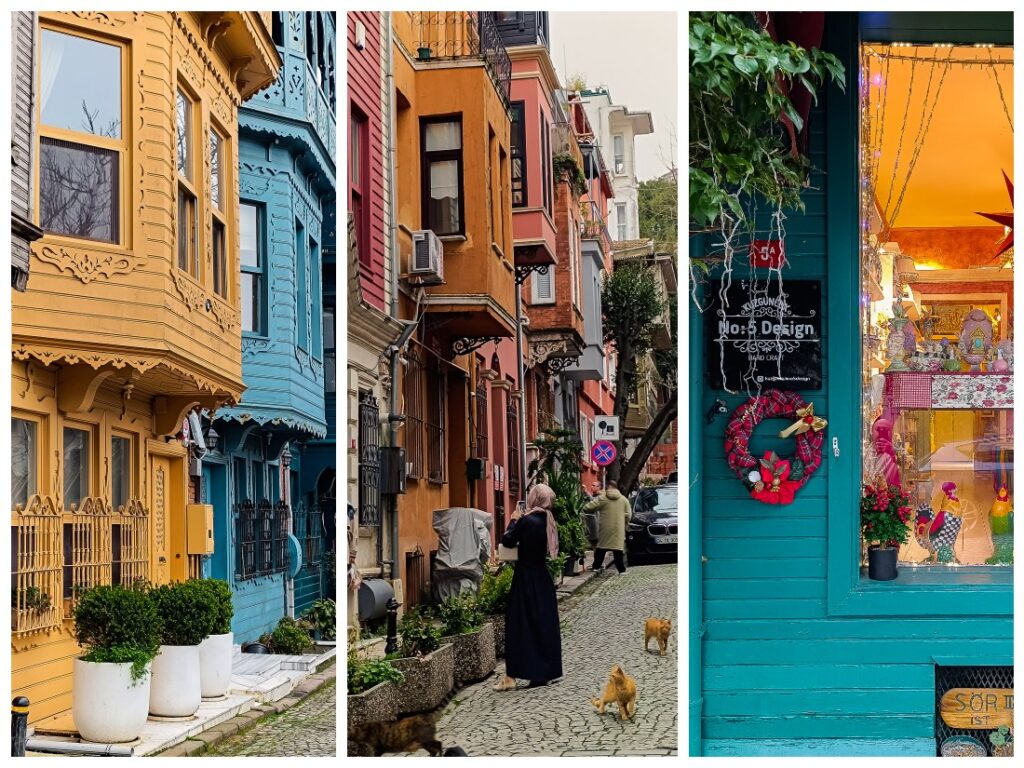
- Fatih — the old district, home to Hagia Sophia, Sultanahmet, the Grand Bazaar, Süleymaniye Mosque, the New Mosque, and nearby, Fener and Balat with their colorful houses.
- Üsküdar — the Asian side, with its waterfront promenade, the Maiden’s Tower, and Kuzguncuk — also known for colorful houses.
You’ll most likely be staying in the Fatih or Beyoğlu districts.
Types of Transport and How to Use Them
Istanbul’s public transport includes: the metro, buses, trams, funiculars, the Metrobüs, ferries, and Marmaray.
Out of all of this, you’ll most likely never need the Metrobüs or Marmaray.
Metrobüs
This is a rapid-transit bus that runs in a dedicated lane. If it’s your first time in Istanbul, you won’t need it, since its route runs outside the main sightseeing areas. It’s mainly there for the convenience of locals, letting them get to work quickly through residential and business districts.
Marmaray
This isn’t a metro line but a full-fledged commuter train that runs under the Bosphorus Strait. It’s the fastest way to get from the European center (Fatih, Sirkeci station, near Eminönü) to the Asian side (Üsküdar) — just 4 minutes. Marmaray also comes in handy if you need to get from Sabiha Gökçen Airport (SAW) to Sultanahmet. The alternative to Marmaray is the ferry. It takes longer, but personally I prefer it — I can take the metro anywhere, but a boat ride… mmm… that’s pure joy!

Tram
You’ll definitely be using the T1 line (Kabataş — Bağcılar). It runs through all the major landmarks: Sultanahmet, the Grand Bazaar, Eminönü, and terminates at Kabataş — practically at Dolmabahçe.
It’s a standard, modern tram line with no payment quirks. You enter the stop through turnstiles. Tap your card on the way in, and that’s it — you can ride all the way to the last stop.
The second tram you’ll come across is the famous red vintage tram on İstiklal Avenue that everyone photographs. If you’re too lazy to walk the whole street to Taksim Square, feel free to squeeze in if you can.

Funicular
Istanbul is a city of endless steep climbs. If you’re planning to walk up from the Galata Bridge to Galata Tower, or from Kabataş to Taksim Square — I won’t be joining you, because I’ll be taking the underground funicular.
- F1 (Kabataş — Taksim): a 2-minute ride uphill and you’re at Taksim. Perfect if you’ve arrived by ferry and want to go shopping at the Vakko store on İstiklal.
- F2 (Tünel): incidentally, the second-oldest funicular in the world (after the London Underground). It connects Karaköy with the start of İstiklal Avenue. Just outside the funicular exit is the stop for the red tram.
The funicular fare is the same as a standard Istanbulkart trip.
I know one couple who had no idea what it even was. They rode the funicular, didn’t get off, and rode back down — treating it like a ride. Facepalm.
Buses
Remember three main rules:
- Board through the front door. Tap your card on the terminal near the driver. Exit through the middle or back doors.
- Press the “Stop” button to get off — they’re on every handrail. If no one’s waiting at the stop and you haven’t pressed the button inside, the driver will just drive past. Press it ahead of time!
- If you’re waiting at a stop and see your bus number approaching while two other buses haven’t left yet, hurry to the back where your bus will be. Buses open their doors and drop off passengers not strictly within the stop’s boundaries — they don’t wait for another bus number to pull away first.
At Taksim, the bus stop is underground (in a tunnel). Buses don’t stop on the square itself.
Ferries
A standard turnstile at the pier. Same price as the metro, but about 100 times more enjoyable.
The boats have restrooms and sell snacks and tea. There’s nothing quite like it — tea in a glass, a simit, and standing on deck with a view of the Bosphorus.
The last ferries leave around 23:00 (depending on the line). If you miss it, you’ll have to take a bus.
Where can you go by ferry, and what lines exist? Don’t download any extra apps or copy down all the routes. Just use Google Maps.
Google Maps for Navigation
Figuring out which type of transport to take, where the right stop is, how much the fare costs, and when the bus arrives — all of this is possible with Google Maps. There are other apps out there, but this is the one I prefer. That’s because in Google Maps I also save places I want to visit and add notes. See something interesting, read about it somewhere — drop a pin, add a note. I do this for every country and city.

Taxis
Ah yes, taxis! They’re supposed to run on the meter. But we all know that taxi drivers everywhere can be crooks. They’ll run the meter, alright, but take you in circles.
For what it’s worth, Uber is available in Istanbul, but I’ve never used it. Honestly, I’ve never needed to.