Where to Find Colorful Houses in Istanbul

Merhaba!
If you googled “colorful houses Istanbul,” Google will first throw Fener and Balat at you. But let’s be honest: Balat today means crowds of people and café prices almost like around Sultanahmet.
And I do have an alternative for you – Kuzguncuk! Already popular, but not yet at peak fame, a small district on the Asian side of Istanbul. Go check out where to walk there and take shots that aren’t overused.


Where to go
We take the ferry to the Asian side. There are two piers — Üsküdar and Kuzguncuk. I suggest going to Üsküdar. There are more ferries going there, and from the Üsküdar pier you can first take a short walk to the popular café-bookshop Nevmekan Sahil — it’s the one with the huge dome.
I wrote about it here: Istanbul’s most atmospheric café-bookshops.
And after fueling up on a “San Sebastian” at Nevmekan Sahil, hop on bus No. 15 (or a 30-minute walk) back the other way to this jewelry shop. A small store with reasonable prices, they have new pieces, vintage, handmade, and factory-made items. If you need a souvenir or something for yourself as a keepsake — definitely stop by. Definitely cheaper than around Sultanahmet.
Right around the corner from the shop begins the district’s main street — İcadiye Caddesi. Just walk straight down it until you’ve had enough (about a kilometer). Then head back, ducking into the side streets, small souvenir shops, and local cafés.


Kuzguncuk: a bit of history
Kuzguncuk is one of the coziest, quietest districts in Istanbul. While you’re there, you actually forget it’s part of a huge megacity. Locals call it “a village within the city.” But the most interesting part is that historically it was one of the most multicultural districts in Istanbul.
One of the first communities to settle here was Jewish. Many people arrived after the expulsion of Jews from Spain, and back then, in the 15th century, the Ottoman Empire took them in.
Later, in the 18th–19th centuries, Greeks and Armenians began settling actively in Kuzguncuk. As a result, the district became a kind of “peaceful neighbor,” a place where religion and culture didn’t divide people.
Surprisingly, for a long time there was no mosque at all in the center of Kuzguncuk. That sounds strange for the Ottoman Empire, but the area was mostly inhabited by non-Muslims, so there was no need for one. Then, in 1952, a mosque was built… on the grounds of an Armenian church.
No conflict, no takeover. The Muslim population in the district simply grew, a place to pray was needed, and there was no free land — so the Armenian community gave up part of its courtyard. The church wasn’t seized or converted; they simply shared the land. A rare case of genuine coexistence.
I’ll tell you more — the whole thing is honestly surreal! An Armenian church, a mosque, a Greek Orthodox church, and a synagogue all sit close together. Within a 500-meter radius you’ve got a bell tower, a minaret, and a synagogue (just don’t buy the calamari rings there). I mapped them all on Google Maps — walk this route and really feel the history.


About the local architecture
Why the houses are made of wood
In the Ottoman Empire, wood was the main building material for residential houses — it was easier and cheaper to source, wooden houses held up better in earthquakes, and they could be rebuilt faster after fires.
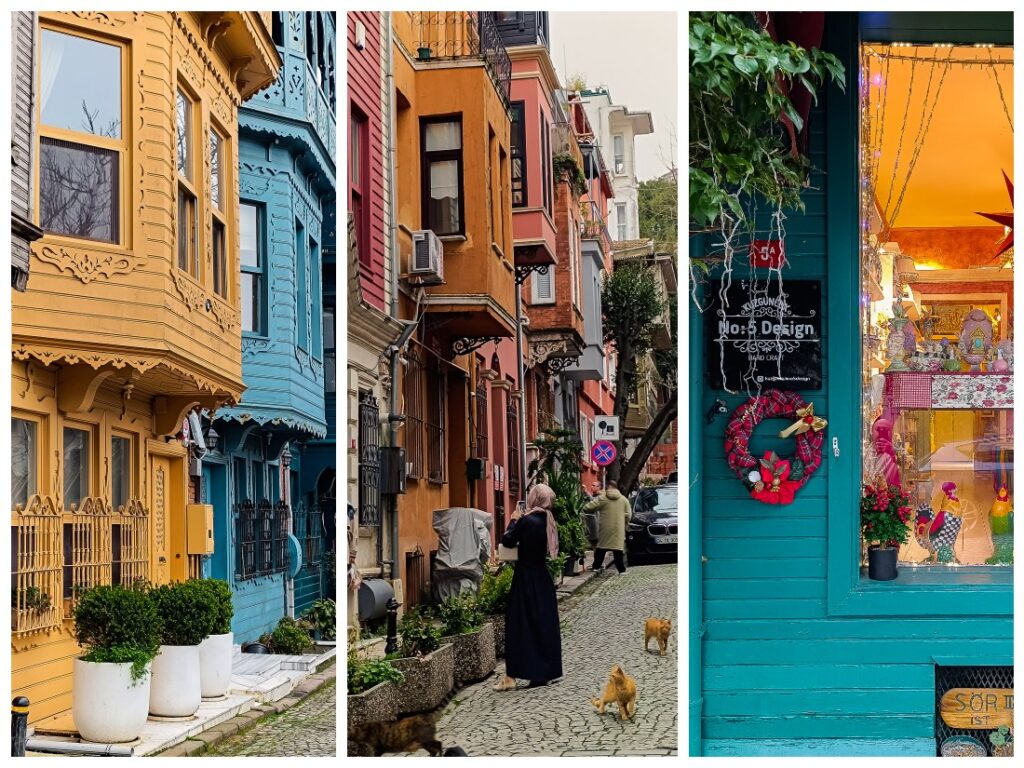
These traditional Ottoman mansions are called “yalı.” In Kuzguncuk they’ve survived better than in many other Istanbul districts, because large-scale development left them alone for a long time. After all, it’s a different, less popular and less crowded part of the city.
After the great fire of 1864, many houses were rebuilt, and that’s when elements of European styles (Empire, Neo-Baroque) came into fashion — rendered in wood.
Why they’re carved
In the Ottoman Empire, carved facade decorations were about status and aesthetics. It wasn’t just decoration — it was a way to show a family’s wealth and taste. And since the carving was often handmade, every house ended up slightly unique.
Why they’re colorful
Houses used to be painted in different shades for practical reasons. Historically, the wood was coated with ochre-based or other natural pigment compounds to protect it from the Bosphorus humidity.
In the 2000s, houses in Kuzguncuk began to be actively restored, and the bright colors became the district’s signature feature. Thanks to that, the district became a favorite filming location for Turkish TV series.


No, of course you should still walk around Fener and Balat too. I didn’t write that post for nothing! And don’t forget about two spots that not even all locals know about — the sultan’s pavilion at the New Mosque and a real bank vault turned free museum. And it’s all free.