Istanbul Museum of Innocence

Merhaba!
Most writers write a book first, and then, if they’re lucky, it gets turned into a movie. Nobel laureate Orhan Pamuk did it the other way around: he wrote a novel and built a real house for it. Not a themed café, not a pop-up installation, but a full-fledged Museum of Innocence in Istanbul, housed in a three-story 19th-century mansion.
Yes, really! Pamuk is simply a genuine madman. He bought a house for his characters and then made them live on the pages of the novel.
Let me tell you a bit about the museum and the book, because if you don’t prepare, you might not understand what’s going on at all.


Location, tickets, opening hours
The museum’s website has mostly useless information: masumiyetmuzesi.org
Getting there is very easy. From the Tophane stop, walk a short way uphill, or head down from Istiklal. Here it is on Google Maps.
Opening hours:
Tuesday, Wednesday, Thursday, Friday, Saturday, and Sunday: 10:00–18:00
Closed on Mondays and January 1st
Ticket price: 750 Turkish lira, audio guide 50 lira. Since prices in Turkey change every month, just in case, in a stable currency – the ticket costs 15 euros.
Tickets are sold at the box office near the entrance. No need to buy in advance. Definitely get the audio guide (available in English)! Otherwise you’ll be wandering around like it’s a junk shop.
If you buy the book (sold in the shop across the street) or already have it, entry is free. You can’t get in with just any copy – there’s a stamp printed at the end of the book.


“The Museum of Innocence” — what the book is about
Warning! Spoilers!
The main character is Kemal, a wealthy young man from Istanbul. He lives a “proper” life and is about to marry a woman from his own social circle.
But then he happens to meet a distant relative, Füsun. And that’s it. Kemal is gone.
They start a secret affair. Then she suddenly disappears. Kemal goes out of his mind and starts searching for her.
By the time he finds her, it’s already too late. Füsun is living a different life now — she has a husband, and everything is complicated. And this is where the real story begins. Instead of letting go and moving on, Kemal starts visiting her, year after year. He just sits there, watches TV, has dinner with her family, and collects all sorts of objects connected to her, or that bring back memories of her — a salt shaker she ate from, a hairpin that fell out of her hair, keys, old tickets.
Kemal turns his love into a museum — a collection of his obsession. And there’s an actual wall covered with 4,213 cigarette butts.
Sounds pretty creepy. That’s usually the kind of thing movie serial killers do, the sort whose garages later turn out to be full of unsettling stuff.


Pamuk’s biggest secret: the objects dictated the plot
The coolest part of this place is the story of how the museum came to be. Orhan Pamuk didn’t just collect props to match what he’d already written. For ten years, he wandered Istanbul’s flea markets alongside writing the book.
He’d buy an old Turkish cup at a flea market, bring it home, set it on the table, and think: okay, so what was Füsun doing with this cup in 1975? The objects literally dictated plot twists to him. He bought the three-story red house in the Çukurcuma neighborhood back in 1999 — nine years before the book was even published. This isn’t an illustration of the novel; it’s one living organism.
And if you read the book first, then standing in the museum, you feel like this story isn’t made up. It’s real. There, look — Füsun’s earrings.


What’s inside the museum
On the first floor, the first thing you see is a wall of 4,213 cigarette butts. A huge panel of cigarettes that Füsun smoked. Under each butt is a date and a short note about what she was doing that day. It looks strange and unsettling.
The next two floors hold 83 display cases, exactly matching the number of chapters. I’ll say it again — definitely get the audio guide. There’s an interesting story behind each one. Pamuk has said that he found some objects before he wrote the corresponding scenes, and sometimes he wrote a scene specifically to explain an object he’d found.
I forgot to check this myself — but if you switch to English, the narration is voiced by Orhan Pamuk himself.
The museum holds thousands of small details from 1960s–70s Istanbul: bottles of the first Turkish cologne, old movie tickets, yellowed photographs. Even if you’re not particularly interested in Kemal’s love story, you’ll see an Istanbul that no longer exists and hear stories about that era.


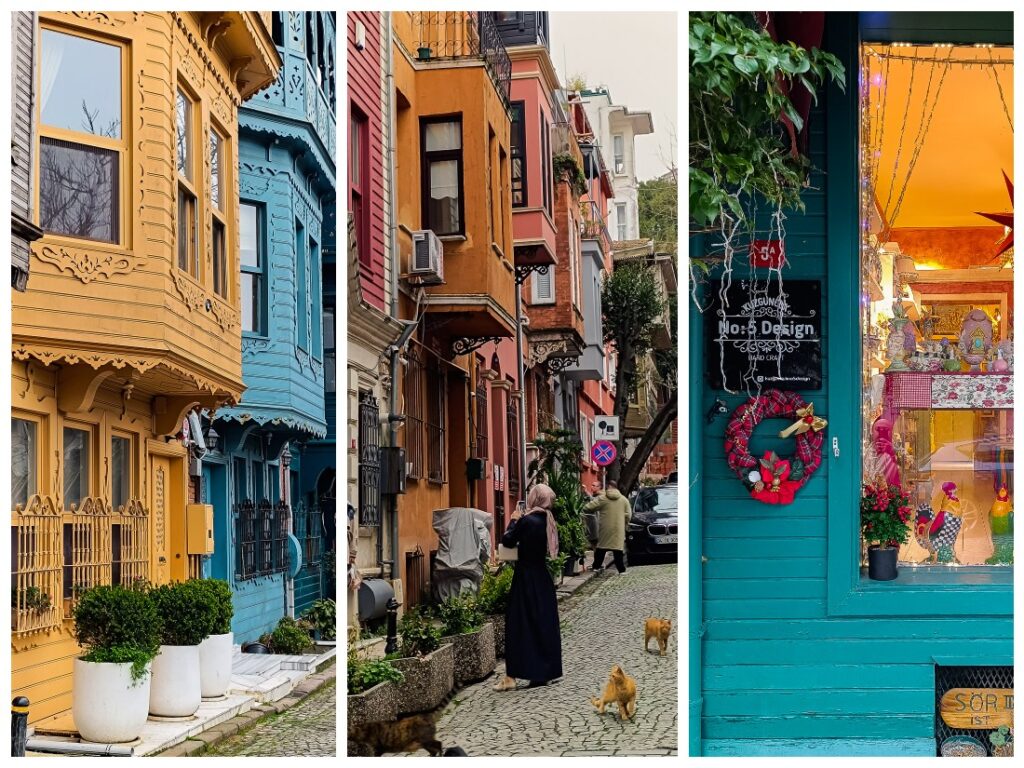
The museum is located in the Çukurcuma neighborhood. If you wander the surrounding streets, you’ll find plenty of small antique shops.