Azores: Sao Jorge

Ola! Bom Dia!
The trip around the Azores continues. We’re flying from Terceira to the neighboring island of São Jorge.
The Terceira – São Jorge flight is operated by SATA, also known as Azores Airlines. Upon arrival, I immediately rented a car at the airport. I’ll return it the next day at the port, from where I have a ferry to another island. What’s great about the Azores is that there’s no oneway fee—no extra charges for dropping off the car somewhere other than where you picked it up.
Best to start here:
- Azores: FAQ – I covered in detail how to get between the islands, which planes and ferries to take, Azorean cuisine, which islands are worth visiting, and other addresses, tips, and tricks.
- Car rental in the Azores – absolutely essential.


Where to stay
The island isn’t very popular with tourists, so there aren’t many accommodation options. In the island’s capital, Velas, there are few hotels, mostly private rentals. Since I didn’t plan to stay long on São Jorge, I booked Tropical Fruit Garden for one night—a large house, half of which is rented out, while the owners live in the other half. Separate entrance, big kitchen-living room, and two bedrooms. Clean and cozy. Definitely enough space for about six people. The host is a former customs officer who worked in Romania.


Where to eat and drink
By the time we got there, picked up the car, and went back and forth a bit, we were absolutely starving. And on São Jorge, we tried the buffet-style lunch for the first time. In Urzelina (a small town on the route), at the family restaurant Urzelina, we got an amazing buffet for just €12 per person—fried and stewed beef, pork, chicken, vegetables, salads, rice, pasta. Plenty of everything. Plus, coffee was included in the price.
We ended up so full that we didn’t need dinner. In the evening, we just went to the store and stayed in at the Fruit Garden with wine, cheese, and fruit. So, there won’t be as long a list of places on São Jorge as there was on Terceira. But don’t think I was on a diet—I made up for it on the other islands.
I highly recommend stopping by any supermarket to buy the local hard cheese, Queijo São Jorge. It comes in different ages; I like the 24-month one, in black vacuum packaging, 300 grams. Costs around €9. It’s sold in stores all over Portugal, not just in the Azores. There’s also seven- and twelve-month aged cheese, which are good too, but the two-year one is just amazing—the flavor really tingles on your tongue.
Or an even better idea—visit a local cheese factory. There’s a half-hour tour with tasting (€7), and you can buy some cheese for the evening while you’re there.


São Jorge: where it is
São Jorge was discovered by Portuguese sailors in the early 15th century. It’s located in the central group of the Azores, next to the islands of Faial and Pico.
The island has an elongated shape—54 km long and only 6 km wide. Around 9,000 people live on São Jorge. The two main towns are Velas and Calheta. The local population is mostly engaged in agriculture, fishing, and tourism. There are two ports on São Jorge, so keep that in mind when buying ferry tickets. The ferry to Pico departs from Velas.


What to see on São Jorge
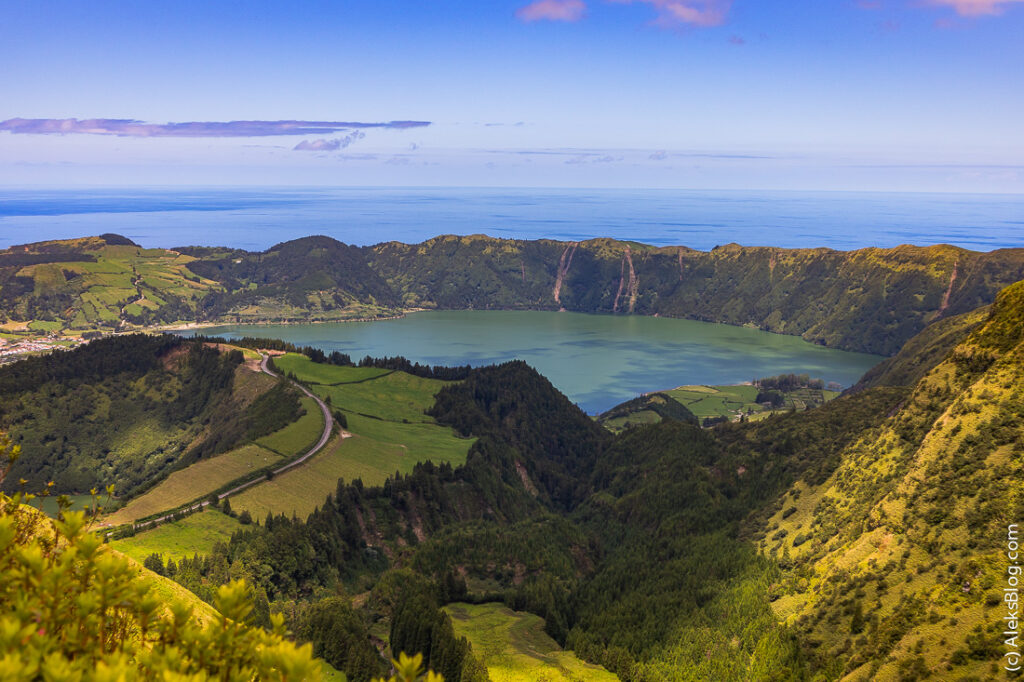
I spent ten days in the Azores in May, and it rained on just one of them. Yes, that day was on São Jorge. The sun only came out closer to sunset, but the day was already lost. So, no chance for hiking. I was lucky enough to snap a few photos from the miradouros, though. Let me share what I saw and what else you can do on São Jorge in one or two days (I had done my homework).
The central part of the island is a mountain ridge with the highest point reaching 1,053 meters—Pico da Esperança. These mountain ranges and active volcanic processes created the fajãs and numerous volcanic craters. A road runs along the ridge, and from the airport you can drive straight to the southwestern tip of the island to the Topo Lighthouse (Farol do Topo). Along the way, you can stop at viewing points and try to catch a glimpse of something through the clouds.
Compared to Terceira, the greenery on São Jorge is incredibly lush, almost like it’s painted on. The climate here is truly unique. Coffee even grows on the island. You can visit a small family plantation in Fajã dos Vimes, see the production—berry picking, drying, roasting—taste it, and buy a bag of beans to take home. Where else are you going to try coffee grown on a volcanic island? As a gift, it’s just perfect.
The weather in the Azores changes quickly, and often you get lucky and the landscapes open up in all their glory.


Fajãs
In Portuguese, the plural is pronounced fajãs (singular – fajã).
One of the main attractions of São Jorge are the fajãs—narrow coastal plains formed by volcanic activity and landslides. They are unique to the island and give it its distinctive look. There are more than 40 fajãs on São Jorge. Some of them, like Fajã da Caldeira de Santo Cristo, can only be reached on foot or by boat. Hikes to and between the fajãs are among the island’s most popular trekking routes.
Which brings us smoothly to the topic of “Where to stretch your legs on São Jorge.”

Guess what this is in the next photo. Hint—it’s something you’ll see a lot of on Pico.
The answer is here (highlight the part of the sentence up to the period): it’s a windmill.

Hiking trails
All hiking routes in the Azores are listed on trails.visitazores.com. You can sort them by duration, difficulty, loop or one-way.
I had planned for us to drive to Serra do Topo, where two trails start from this parking area. One of them, PR01, leads to Fajã da Caldeira de Santo Cristo and then on to Fajã dos Cubres. The trail is about 3 hours long, descending from the mountains and then following the ocean between the fajãs. I’ve already mentioned the first fajã, Santo Cristo—the one you can’t reach by car.
Between the two fajãs along the way there’s another one, Fajã do Belo. So, three fajãs in total. At the last one, Fajã dos Cubres, there’s a road, and that’s where we had planned to have dinner and then ask for a taxi back to the Serra do Topo parking lot. But in the rain, I wasn’t up for the hike. My paws were not ready for it…
If you take this trail, you’ve got two assignments! First, in Santo Cristo, check out the early 19th-century church. Second, in one of the restaurants you should try Amêijoas à Bulhão Pato. These are white clams, similar to vongole. There’s a funny bit of history here. Raimundo António de Bulhão Pato (or simply Bulhão Pato) was a 19th-century Portuguese poet. The clam dish was first prepared by João da Mata, a chef at Lisbon’s Central Hotel, and named after the poet, who was also a well-known gourmet. And “pato” in Portuguese means “duck.” Some people first think it’s clams in duck broth. Nope, the recipe is very simple—white wine, salt, pepper, cilantro, garlic, and clams. You can try it all over Portugal, but they say it’s best in these parts.


View of Velas — the administrative center of the island. The next day we had a ferry to Pico.


At the port of Velas, we left the car with our backpacks in the parking lot and took a short walk around the capital. Then we came back, returned the car, and off we went to a new island.
As they say, to be continued. Links to the other islands:
Terceira – São Jorge – Pico – Faial – São Miguel.