Faial Island Azores

Olá! Bom Dia!
Continuing my journey through the Azores, and now we’re on the fourth island – Faial.
What? You missed everything? Okay, here’s a quick reminder for the second-to-last time. In previous posts, I already covered the islands Terceira – São Jorge – Pico.
Although it’s probably best to start here:
- Azores: FAQ – I went into detail about getting between the islands, which planes and ferries to take, Azorean cuisine, which islands to visit, and other tips, addresses, passwords, and instructions.
- Car rental in the Azores – absolutely essential, you can’t do without it.
How to get to Faial
I came by ferry from Pico. Just half an hour across the ocean.


Where to stay
Of course, in the capital. Horta – the main city on Faial.
In Horta, we stayed at Casa da Baia. The pluses of this hotel are the price and the location. Although, that’s also a minus. The hotel is in the center, close to the nightlife spots, so until 3 a.m. there’s shouting, partying, drinking and fucking right under the windows. The room is small, just a bed with about half a meter of space around it. Cozy? Think more like a hospital ward. There’s a shared kitchen area with free tea, coffee, and cookies. Parking is available, though getting a spot right in front of the hotel is tricky – but within walking distance you can find one, even for free.
If you want cheap, stay at Casa da Baia. If you want affordable and comfortable, here are a couple of centrally located options near the waterfront – Hotel do Canal (I parked the car nearby) and Azores Faial Garden (has both indoor and outdoor pools).


Where to eat and drink
- Restaurante Bela Vista – on the way to Capelinhos, I recommend stopping here for lunch.
- Aldina – we had lunch here on the second day, nothing particularly outstanding. There was nothing else around.
For dinner and a few drinks, of course, Peter Sport Bar. I’ll tell you more about it later. There are two entrances and two rooms. If you’re facing the place, take the entrance on the left, where the bar counter is. When there are no seats inside and you just want to quench your thirst, you can grab a mug at the bar and sit on the waterfront. Everything is pretty relaxed and casual.

Faial
Faial Island was discovered in 1427 and colonized in 1432 by Portuguese settlers, many of whom came from Flanders. Today, about 15,000 people live on the island.
The name Faial comes from the Portuguese word “faias,” referring to the abundance of Myrica faya – the “laurel tree.” This plant was widespread on the island at the time of colonization.
However, the hydrangeas, which now cover the island with their blue blooms and create landscapes of incredible beauty, later became a symbol of Faial and earned it a second name – “The Blue Island.”
There aren’t any hydrangeas in the photo because I was there in May, and they bloom in summer. But in summer, everything along the roads is drowned in flowers – not just blue ones. I saw the same on Terceira in July.


What to do and see on Faial
In two days, you can: see the huge volcanic crater in the center of the island and walk along its edge, take a short hike along ancient water channels surrounded by endemic flora, check out the unique volcanic landscape formed by the 1957 eruption, visit the Volcanology Museum, study all the drawings in Horta Marina – the yacht harbor, enjoy an evening at the iconic bar, explore old ruined lighthouses and churches, and discover 400 endemic species in the local botanical garden.
Capelinhos
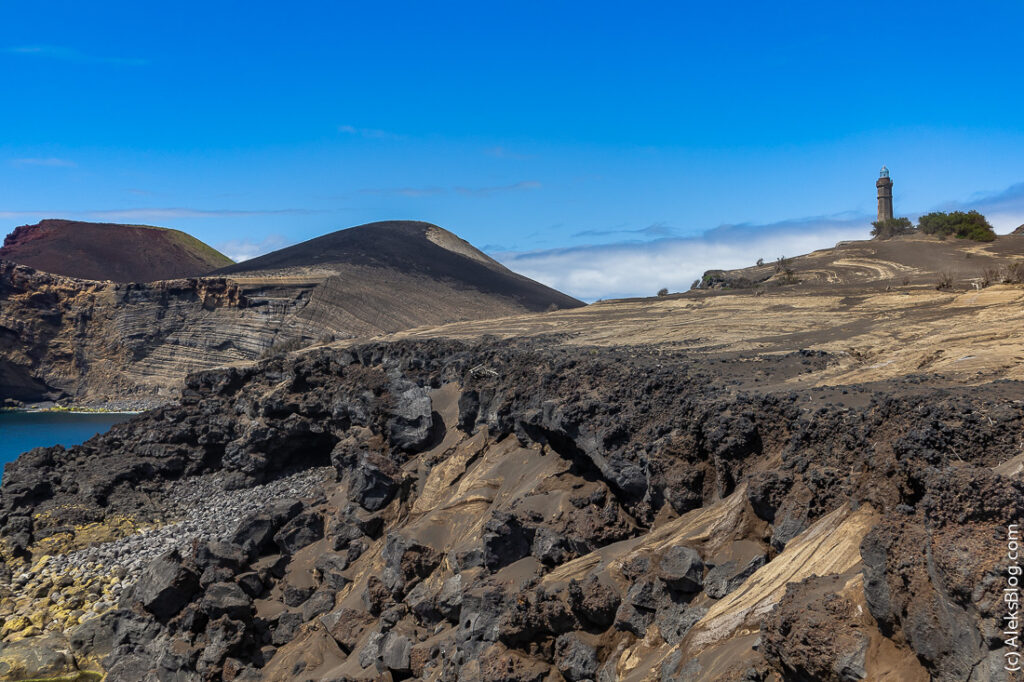
One of the most impressive spots on Faial is Capelinhos – a stretch of land on the western tip of the island formed by the 1957–1958 volcanic eruption. The volcano erupted from the ocean, not far from the island’s shore. As the lava settled and cooled, Faial’s landscape changed dramatically, adding about 2.5 square kilometers of new land. The atmosphere is totally otherworldly, with a landscape of black sand and lava.
Don’t rush straight to the Volcanology Museum and the lighthouse. First, drive to the end of the road, where there’s a viewpoint overlooking the surviving lighthouse and Capelinhos. After that, you can go to the parking lot and look for the museum entrance. It’s a little quest in itself.


Church of São Mateus and Ribeirinha Lighthouse
On Faial, there are two photogenic abandoned spots you simply can’t pass without stopping.
In 1998, an earthquake measuring 5.9 on the Richter scale struck 5 km off the coast. As a result, houses in several villages were destroyed, along with the Ribeirinha Lighthouse (built in 1915) and the Church of São Mateus.
Interestingly, the Church of São Mateus was built in 1934 on the site of an earlier church from 1666, which had been destroyed by the 1926 earthquake.


Horta Marina
Horta Marina is known not only as an important stop for everyone crossing the Atlantic but also for its unique pier paintings.
Every crew arriving in Horta leaves a commemorative painting or inscription on the marina walls, which, according to tradition, brings good luck on future voyages. These vibrant frescoes turn the marina into an open-air gallery, where each painting is connected to a journey across the ocean.


Peter Sport Bar
After finishing their sail or just stopping by Horta, all sailors head to Peter Sport Bar, which has been operating since 1918.
The bar has become a true legend among sailors and travelers.
Pick up a side job, drop off a package, find fellow travelers in either direction – for over 105 years, this bar has witnessed both the tears of farewells and the joy of reunions. By day, it’s a regular café. By night, it embodies the spirit of freedom for the entire marina. In every language, for all ages. Peter isn’t just a bar; it’s a meeting place where the paths of those who conquer the ocean intersect.


Waterfalls and Levadas
Faial doesn’t have large waterfalls like those on other Azores islands – São Miguel or Flores. However, you can find small natural streams and springs, especially in the wetter, greener parts of the island.
For example, Poço das Asas. Just keep in mind that the “waterfall” only appears after rain. At other times, it’s still beautiful – huge ferns, various endemics – but without flowing water, at most some puddles.
The levada on Faial was built in the 1960s. For me, it was one of the most enjoyable trails. Most of the path runs in the shade of trees. The route is linear, so I only walked halfway and returned to the car. Parking and the trailhead are along the levada. As usual, detailed information is on trails.visitazores.com. It’s best to walk this route in dry weather.


Caldeira
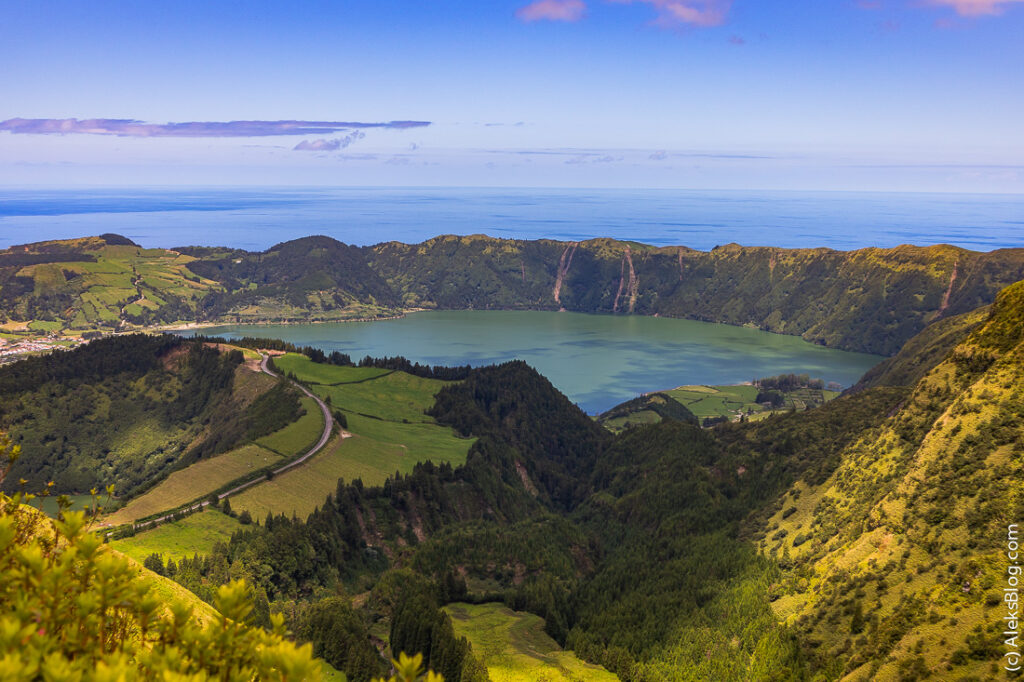
The Caldeira is an impressive crater of an ancient volcano, located in the center of the island. The trail runs along its edge, offering views of the huge crater, about 2 km in diameter, covered in greenery. Inside the crater, there are either birds or pterodactyls flying around – hard to tell.
Along the rim of the Caldeira, there’s an easy 7 km circular route; more details at trails.visitazores.com. We completed it in 2 hours. The path is fairly even, with slight elevation changes, and the views of Pico are absolutely stunning!


Up next is the last one, but the biggest of the Azores – São Miguel. This one isn’t part of the central islands, so you can’t get there by ferry. That means it’s time to fly. In Azores: FAQ, I showed the local propeller shuttle.
So, as they say, to be continued – links will be added.