Sao Miguel Azores

Olá! Bom Dia!
So, in my little journey around the Azores, the last island left is São Miguel. If you missed everything again, I won’t recap—just start here:
Azores: FAQ – I covered in detail how to get between the islands, which planes and ferries to take, Azorean cuisine, which islands are worth visiting, and other addresses, tips, and tricks.
São Miguel belongs to the western group of islands—no ferry can get you there, it’s far. But just under an hour by plane from Faial to Ponta Delgada, the capital of São Miguel.
At the airport, I dash to the rental desk, ten minutes for formalities, grab the keys, throw my backpack in the trunk, and hello, Ponta Delgada. The airport is just 3 km from the city.
Car rental in the Azores – why you need to rush to the desk, plus other useful tips.


Where to Stay
In Ponta Delgada, we stayed at MS Vila Nova. A large hotel (by local standards, it even has an elevator). Nice room, balcony. Everything you need in Ponta Delgada is within walking distance. And by “everything you need” I mean the waterfront, bars, and restaurants—perfect for an evening stroll after a day exploring the island.
As I already mentioned, the airport is just 3 km away. The first time I heard the sound of a plane coming in to land right over the hotel, my first thought was that it’s going to crash into our fifth-floor balcony. I don’t know about anyone else, but by the time the second plane came in, I was actually enjoying it. I even checked the schedule, waiting for the next one. Don’t worry—planes don’t fly at night.
Overall, I liked the hotel. There are some nuances with parking, I won’t rewrite them here—they’re covered in Car Rental in the Azores.


Where to Eat and Drink
- Restaurante Estradinho – a small restaurant located just across the street from the hotel. The best lapas in all the Azores. Big, juicy. Fish, meat, everything is cheap and comes in large portions. Definitely recommended. They don’t take cards, cash only.
- O Churrasco – grilled meat, poultry, and fish. Open kitchen, the smell fills the whole street, and your mouth starts watering as you approach. Don’t forget Azorean restaurant quirks and book a table in advance. Or come an hour before closing.
- Ned Kelly’s Irish Pub – one evening we just wanted a Guinness… The beer at Ned’s is okay, the food is not. We ordered wings in a spicy sauce to go with the Guinness. They were awful, clearly cooked long ago, frozen, and reheated in a microwave. Topped with sauce. Not marinated, just drowned in Mivimex. The burger was the same. If you’re tired of Portuguese Super Bock and want Irish beer, you can drop by, but don’t eat here.
- São Nicolau – when you’re in Sete Cidades, stop by for lunch after a trail. Large hall and at lunchtime the buffet offers the best selection. For €12 you get a plate and can take whatever you want. On weekends the price is a couple euros higher, but you’ll get seafood.
- Restaurante Tony’s – in the village of Furnas, near the geothermal area, you must try the local dish, cozido das Furnas. Azores: FAQ – read it already, all with photos. Tony’s was chosen for the meal. Haha, whether for lunch or dinner, try to get a table. If you didn’t book, there’s a waiting list. Come back in an hour and a half. So, make a reservation.
- O Miroma – in the end, in Furnas we went to this restaurant. Everything was booked too, but we only had to wait for the first available table. Cozido, like everywhere, is only made to order, but we got lucky: someone didn’t show up or leftovers were scooped up, so we tried this steamed meat with vegetables. Taste buds weren’t blown away. There’s that subtle hydrogen sulfide aroma—definitely an acquired taste. On the plus side, the feijoada was decent. I really should put together a guide to Portuguese cuisine.

São Miguel: Where It Is
São Miguel is the largest of the Azores islands, discovered in the early 15th century by Portuguese navigators. It covers an area of about 746 square kilometers, making it the biggest of all nine Azores islands. With a population of around 137,000, São Miguel is also the most densely populated island in the archipelago.
What to See on São Miguel
I can’t single out one Azores island as my favorite or least favorite. They’re all different, each with its own unique features. But São Miguel has a few more interesting spots and hiking routes. If you’re choosing just one island to visit in the Azores, then definitely São Miguel.
What to see on São Miguel: pineapple plantations, tea plantations, geothermal zones, waterfalls, an abandoned hotel, crater lakes, a botanical garden, thermal pools, rugged cliffs, the endless ocean, and whales.
Ponta Delgada
Like on all the Azores islands, the must-see spots are outside the cities. People go to the Azores for nature. Walking around the towns—save that for Porto and Lisbon. In Ponta Delgada, it’s nice to take an evening stroll along the waterfront, wander a bit into the side streets, and admire the local architecture. A key landmark is Portas da Cidade – the city gates with arches, dating back to the 18th century.

Whale Watching
The Azores and Madeira are perfect places for anyone wanting to see the giants of the underwater world: the center of the Atlantic, right along the migration routes of whales and dolphins.
You won’t see whales from the shore—you need to head out into the open ocean. Tours run year-round, but the peak season is from April to October. On the Azores, I didn’t have enough time, so I didn’t get to see any whales. In December, on Madeira, I saw someone’s huge tail—most likely a sperm whale—quite close to the boat. It was scary, really scary. If you spot a whale in the Azores, buy a lottery ticket the same day. I’m serious.
There are two types of whale-watching tours: on a high-speed Zodiac catamaran (a nightmare for anyone with back problems) or on a regular boat. During the season, it’s best to book in advance. Major operators: Azores Whale Watching Terra Azul (high-speed catamarans) and TERRA AZUL Futurismo Azores Adventures (offers both options).
Pineapple Plantations
Located within the city of Ponta Delgada. Entry is free, and several greenhouses are open to visitors. There’s also a café and a souvenir shop.
Until the mid-19th century, the Azores exported oranges to Europe. But at some point, due to citrus tree diseases, orange exports dropped sharply. Pineapples became an excellent alternative.
The Azorean climate isn’t ideal for pineapples, so they’re grown in greenhouses rather than open fields. The process takes about two years.
Interestingly, the Portuguese use the word abacaxi for imported pineapples, while ananas refers to those grown in the Azores. Pay attention next time you visit the fruit section in any store in Portugal.


Tea Plantations
There are two tea plantations: Gorreana and Porto Formoso. One was enough for me—Gorreana, the oldest and most famous factory, founded in 1883. The place is popular; we had a hard time finding parking. Porto Formoso is a factory that revived operations in the early 2000s.
Even if you’ve been to Munnar in India, I recommend visiting Gorreana—to see how tea grows, taste it for free in the café (there’s a large thermos, you pour yourself and drink as much as you want), check out the small exhibition of old production methods, and buy some tea to take home.
In the early 19th century, settlers on São Miguel brought tea seeds from Brazil, but… it didn’t quite turn out right. In 1874, two specialists were brought from China to teach the islanders how to properly grow, process, and dry tea leaves. The Azorean tea business then took off—in the mid-20th century, exports reached 250 tons, and about 14 tea factories operated on the island.
Competing with countries like India and Sri Lanka in tea cultivation and production is tough. Gradually, their products began to dominate the market, pushing Azorean tea out. By the end of the 20th century, only two factories remained on São Miguel. Today, tea exports total around 40 tons per year.
The island produces black and green tea. Black tea varieties:
-
Orange Pekoe (OP) — high-quality tea with long, twisted leaves.
-
Pekoe — tea with shorter leaves and a rich flavor.
-
Broken Leaf — smaller tea leaves with strong astringency, usually used for bagged tea.
All of these are sold in the plantation shop. I bought a bag of each.


Sete Cidades Craters
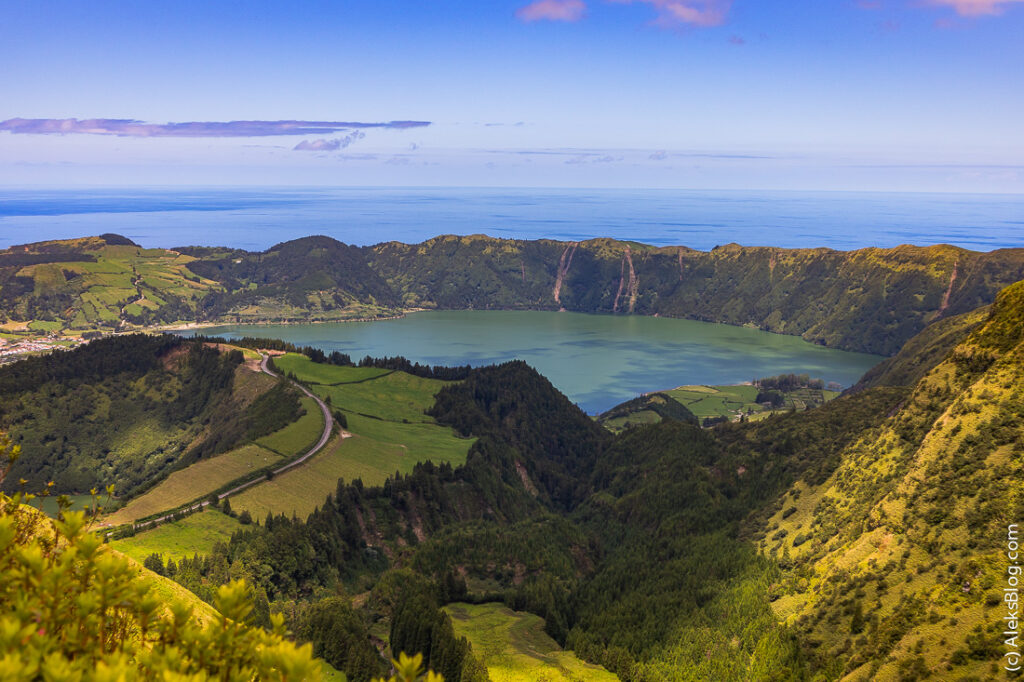
One of the most impressive and well-known natural sites on São Miguel.
The Sete Cidades volcano is one of the largest active volcanoes in the Azores. Its caldera, about 5 kilometers in diameter, formed 22,000 years ago. The last significant eruption in the area occurred around 500 years ago. The volcano is currently dormant.
Over thousands of years, a unique landscape developed around the Sete Cidades craters, with the highlight being two lakes separated by a narrow isthmus:
-
Lagoa Azul (Blue Lake) — appears blue due to the reflection of the sky on its surface.
-
Lagoa Verde (Green Lake) — has a greenish hue created by surrounding vegetation and the reflection of nearby hills.
According to legend, the two lakes were formed from the tears of two lovers—a princess and a shepherd—who were separated because of their social status.
Where to See Sete Cidades
Two options:
-
Park your car and walk about two kilometers to the Miradouro da Boca do Inferno viewpoint. The path is simple, surrounded by pine trees, passing a small lake, Lagoa do Canário, until you reach the viewpoint. This is one of the most photogenic spots on the island, offering views of both Lagoa Azul and Lagoa Verde. From the viewpoint, you can follow the trail along the caldera ridge, turning back to the parking lot anytime or continuing to the village of Sete Cidades.
-
Drive to Vista do Rei – a viewpoint with the most spectacular view on the island.
There’s also Lagoa do Fogo, another crater lake near the Água de Pau volcano, in another part of the island. I didn’t manage to visit it this time, leaving it for next time. If you go, here’s the trailhead and its description on trail.azores.com. It’s a circular route taking about four hours.


Abandoned Hotel
In any case, you should go to the Vista do Rei viewpoint. Besides the view of Sete Cidades, there’s another local attraction there.
This is Monte Palace, or rather what’s left of it. In 1990, Monte Palace was the most luxurious hotel not only in the Azores but in all of Portugal.
Five floors, 88 luxury rooms, two restaurants with silver cutlery and crystal glasses, a nightclub, a bank, beauty salons, and boutiques.
From every balcony, the hotel offered a royal view of the lake inside the volcanic crater and the Atlantic Ocean.
Eighteen months after opening, Monte Palace won the award for the best hotel in Portugal and… in the same week, it was closed forever.
The problem was that the hotel opened at the wrong time. In the 1990s, neither São Miguel nor the Azores were popular tourist destinations. Air connections to the mainland and inter-island ferries appeared much later. So the clientele was limited to wealthy Portuguese. Add poor roads and underdeveloped car rentals. There was simply nothing for affluent guests to do on the island. And hiking? Nobody cared about that back then.
After it closed, a guard with a dog watched the hotel for 20 years. But when he stopped getting paid and access became free, locals took everything—literally everything, even the elevator.
In 2017, the hotel was bought by Chinese investors who were supposed to reopen it in 2021, but nothing has happened yet.
To get into the hotel, you don’t need to climb over the fence. Where you see a road sign in the photo is the façade; walk around the hotel along the perimeter by the fence, and you’ll find an open entrance.


Salto do Cabrito Waterfall
Long texts can be a drag too. Hang in there, just a little more.
Let’s take a break for a waterfall — Salto do Cabrito. From the parking lot, it’s about a twenty-minute walk downhill on asphalt. The slope is steep. Some people drive down, but there’s a “no entry” sign… I don’t do that.
By the waterfall, I was alone — no tourists. Imagine: 25°C, light drizzle, a faint mist from the spray, silence broken only by birds (probably) calling in the bushes, trees all around, millennia-old ferns, a babbling stream, and the waterfall flowing among the rocks. Yes, it’s not very tall or spectacular, but you really soak in the surroundings and the atmosphere. Feels like I’m Indiana Jones, and any second pygmies will jump out of the bushes and… No, bad imagination. Better stick to German cinema, and I’m a plumber.

Furnas Geothermal Zone
Furnas – this region on São Miguel is known for its volcanic activity, numerous hot springs, geysers, and unique geothermal cuisine.
What is the Furnas geothermal zone?
Furnas is a volcanic caldera formed after a massive eruption thousands of years ago. Yes, the Azorean volcanoes are “dormant,” but they remain geothermally active, which shows in hot springs, fumaroles (steam vents), and thermal lakes. It’s one of three active geothermal zones on São Miguel.
Fumarolas Lagoa das Furnas – a natural park with boardwalks and trails around the lake. If you drive there, the fee is €3 per person. Cash only. Reviews mention someone literally blocking the road and demanding money. That’s not exactly true. There really is an entrance fee. You can park on the roadside and go to the ticket office to pay. Or one of the staff may come to your car and collect the fee on the spot, so visitors don’t have to get out and everyone moves faster. Payment is cash only. At the ticket office, you might be able to pay by card, but it’s better to have cash.


Cozidos das Furnas – a traditional Azorean dish cooked using geothermal energy.
In the photo, you can see many pits with lids, each belonging to a different restaurant. In the kitchen, they pack a pot with an assortment of meats and vegetables—a stew, basically. Specially trained people deliver the pot and leave it buried for about eight hours. These “burying specialists” are perfectly normal people. Later, they retrieve the pot, take it to the restaurant, and serve it immediately. This dish is only served in the village of Furnas.


Caldeiras Furnas – In Furnas, park pur car and check out the fumaroles before lunch; they’re all in one place. Everything is free.
Not Yellowstone, but I really enjoyed it everywhere.


Terra Nostra Botanical Garden
Terra Nostra was founded in the 18th century. Here, you can stroll among rare plant species and swim in thermal pools with warm mineral-rich water.
The garden has several thermal pools fed by natural hot springs. The main pool is a large thermal pool with iron-rich water, giving it a distinctive orange-brown color. The water temperature is 35–40°C, and it’s swimmable year-round.
Be sure to bring a towel—most likely your hotel one. I don’t know how you’ll manage, but try to avoid a white towel, because the reddish stains are hard to wash out. And don’t swim in white either. Showers and changing rooms are available.
Besides the main thermal pool, Terra Nostra has other smaller hot baths, “hidden” among the trees. If you can chase away all the British teenagers, you can enjoy a relaxing soak in a natural, intimate setting.


I spend half a day in a botanical garden.


Waterfall, Sequoias, Neo-Gothic Chapel
We leave the car in the free parking lot. This is the southern part of Lagoa das Furnas, and if you have plenty of time, you can walk from the northern side (where the fumaroles and boardwalks are), or vice versa.
We head to see the chapel and the waterfall.
Part of the route goes through private property, with an entrance fee of €4 per person. From the entrance, turn left to reach the waterfall, or right to go north toward the fumaroles. But remember, Cinderella: the gate closes exactly at 18:00! Yes, access is not 24/7.
The walk is easy, like a stroll through a park. Anyone can do the trail.
Capela de Nossa Senhora das Vitórias – a small but impressive chapel. Built in the mid-19th century by landowner José do Canto in memory of his wife Maria, who died young. He personally designed the chapel in a neo-Gothic style. I haven’t seen another building like it in the Azores. The chapel is closed, so you can’t go inside, but you can peek through a window and admire the stained glass.


Following the signs, we walk for forty minutes. Through the forest, in a straight line, first reaching the area where the sequoias grow.


Another ten minutes, and there it is — a gateway to the Lost World. I sat there in silence for half an hour, until a group of French retirees came stomping along.