
Must-Try Georgian Dishes

Gamardjoba!*
Let’s start with the highlights – yes, of course, khinkali, because it’s the most iconic Georgian dish and, for some reason, everyone thinks that Georgia is all about khinkali and khachapuri.
*Which in Georgian translates as “Greetings!”
Khinkali
Khinkali isn’t made just with meat – there are also versions with cheese, mushrooms, or potatoes.
In khinkali restaurants, you’ll find a huge variety, not just the classic meat ones: kalakuri – meat with herbs, mtiuluri – meat without herbs, kazbeguri – chopped meat, and kakhuri – pork (usually they make it with beef).
Khinkali are ordered individually and eaten hot, before they cool down. They go especially well with chacha. Khinkali are very filling, so it’s better not to order too many at once – about six for two people, leaving room for other dishes.
How to eat khinkali correctly
Cutting khinkali with a knife and fork is an insult to Georgian feelings. Please, don’t do it.
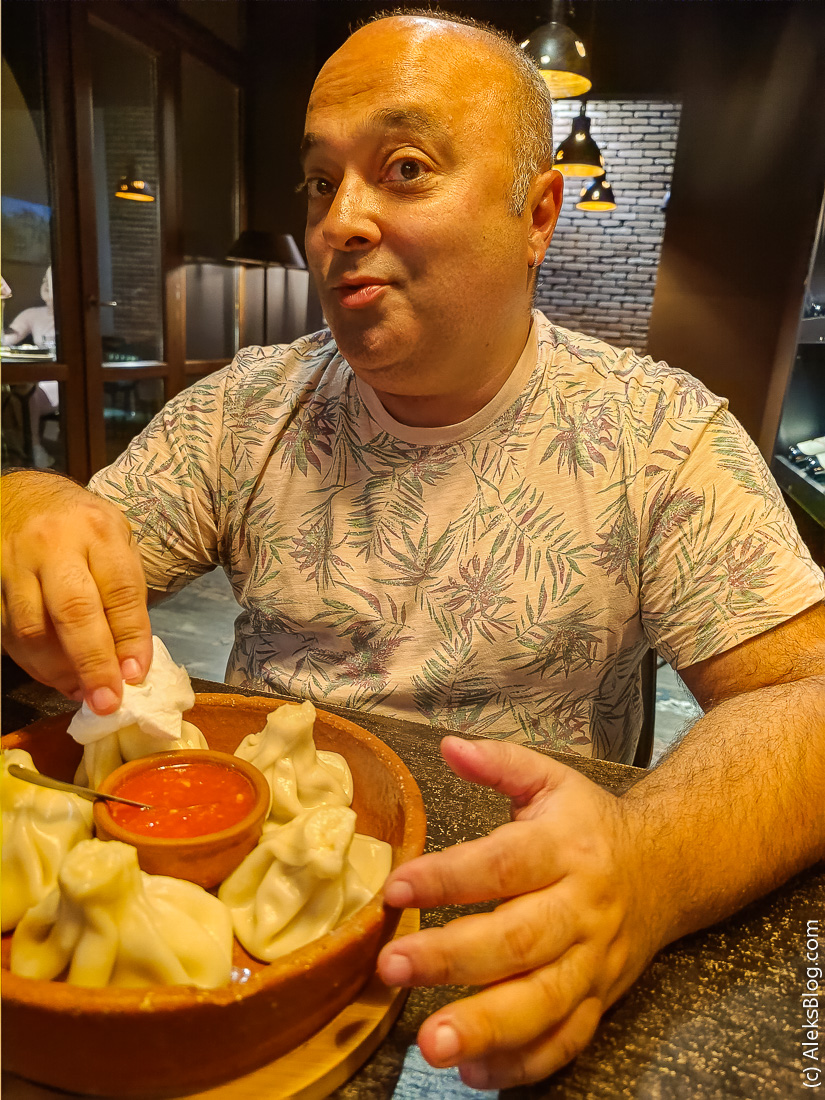
You hold khinkali by the “tail,” take a small bite, drink the broth, and then eat the rest. The tail is discarded. Eating it this way requires some skill because it’s hot, khinkali can slip from your hand, and when you try to bite it, it might fall apart, fly off, and splash everywhere.
I tear off a small piece of napkin, wrap the tip of the khinkali, hold it with my left hand, support it with my right (or with a spoon or fork), take a bite, drink the broth, and then eat the rest.
Appetizers
Pkhali – vegetables or greens (usually beetroot, spinach, or beans) mashed into a paste with nuts and spices.
Badrijani – eggplant rolls with a nut paste and spices. A divine snack with vodka or chacha. Yes, I know about cold appetizers and landlords, but try it first.
Gebjalia – rolls of sulguni cheese with mint, served in a matsoni sauce.
Mzhave – a set of pickles: peppers, cucumbers, tomatoes, sometimes red cabbage.
Dolma – small cabbage rolls wrapped in grape leaves, also considered an appetizer.
Mzhumi – Georgian-style jellied meat.
Satsivi – pieces of fried turkey (or chicken, or fish) in a nut sauce with spices.
Soups
All soups in Georgia are delicious! Be sure to try everything you see on the menu (though, of course, not all at once).
Kharcho – forget all the kharcho soups you’ve tried before. In Georgia, it’s simply mind-blowing. In my opinion, 10 out of 10. It’s made differently everywhere. The spiciness is very pleasant – not the Asian “call the fire brigade” kind, but warming. Kharcho can be made with beef or chicken, and there are vegetarian versions with eggplant. Always served with herbs. And they always add tklapi – a purée made from plum pulp.
Chakapuli – my number two soup. Made with meat and a large amount of fresh herbs – tarragon, cilantro, parsley. Tkemali and cherry plums are always added. The result is a slightly tangy, refreshing, and very tasty soup.
Chikhirtma – a very unusual soup, made with a thick chicken broth (sometimes beef), without any vegetables. At the end, it’s thickened with cornmeal and eggs. Served sprinkled with fresh cilantro.
Khash – to put it simply, it’s jellied meat while it’s still hot. Very fatty, with garlic. Perfect for the morning after a night of too much chacha.
Sauces
Satsibeli – a delicate tomato sauce.
Tkemali – a sour plum sauce. Goes very well with meat.
Adjika – nothing special, just a spicy (for me, not at all) tomato sauce.
Bazhe – a nut sauce, which I don’t find very impressive.
Narsharab – a sour sauce made from reduced pomegranate juice. Technically, it’s an Azerbaijani sauce, but you’ll also find it in Georgia.
Salads
I know only one salad in Georgia that you absolutely have to order – fresh vegetables with a nut dressing! You can also add fresh herbs – a mix of tarragon, parsley, cilantro, and onion.
Baked Goods
Immediately everyone thinks of khachapuri. And of course, it has to be in the boat shape with an egg on top. But khachapuri comes in different types!
Imeruli – Imeretian khachapuri. A large round flatbread with cheese inside. They use Imeretian cheese, similar to Adyghe.
Megruli – Megrelian khachapuri. Cheese is not only inside but also on top, baked to a golden crust.
Adjaruli – Adjarian khachapuri. In the shape of a boat, with cheese and a raw egg on top.
I prefer the Megrelian one. Imeretian is too dry, and Adjarian has too much dough. Khachapuri is usually very large. Don’t order it as an extra dish—you won’t have room for anything else.
Kubdari – for me, this is the tastiest pastry in Georgia. Kubdari comes from Svaneti. Like khachapuri, but filled with chopped meat and spices. Yes, for me, meat in dough tastes better than sulguni. The best kubdari can only be found in Svaneti, and even there, not everywhere. As Tbilisi locals say – it’s because they add cannabis there.
Lobiani – a flatbread with mashed beans inside. I don’t like it.
Shoti puri – regular bread, baked in brick ovens on every corner and served in all restaurants.
Hot Dishes
Remember this word – ketsi. It’s a skillet made of clay or black stone, used to cook various dishes.
Mtsvadi – or shashlik – grilled meat in Caucasus. On menus, it may also appear as suki. The best shashlik is in Armenia. All the Georgian shashlik I’ve tried is not tasty. The meat is usually dry, sometimes too sinewy, and occasionally the cooked shashlik is fried again in a pan with oil. In general, Georgians don’t make shashlik or just fried meat very well.
Chashushuli – veal (or chicken, or mushrooms) stewed in a ketsi with spices and herbs.
Ojahuri – potatoes fried in a ketsi with meat. Simple and tasty, no frills.
Shkmeruli – chicken stewed in milk with a huge amount of garlic. When I first ordered shkmeruli, I didn’t expect it to be a whole chicken. Don’t make my mistake.
Kuchmachi – chicken gizzards, liver, and hearts finely chopped and fried in a ketsi.
Ajapsandali – very, very tasty. Some consider it an appetizer, but I think it’s a full, hearty main dish. Ajapsandali is a stewed vegetable dish with eggplant, tomatoes, peppers, onions, garlic, spices, and herbs. It can be served hot or cold.
Lobio – beans stewed in a pot with garlic, cilantro, and tomatoes. Considered one of the main and most loved dishes in the Caucasus. Some say there’s no one who doesn’t like lobio. Well – that’s me. I don’t like lobio; I only eat it when there’s nothing else. Georgian cuisine has plenty of other delicious dishes.

Non-Alcoholic Drinks
Lemonades! Any bottled ones – Natakhtari, Zedazeni, Lagidze, or whatever is on the menu. If you’ve never tried Georgian lemonades, on the day you arrive, the first thing you should do is run to a store and buy every brand and every flavor – tarragon, pear, lemon, creamy, grape, feijoa – get them all! Each producer has a different taste.
In some cafés, you can find Lagidze Waters – carbonated water with syrup from Georgia’s oldest lemonade producer, Lagidze. Personally, I don’t find the taste very impressive. But in bottles, chilled, it’s simply divine in the heat.
Mineral water isn’t just Borjomi. Interestingly, most Georgians we spoke to prefer other brands, like Nabeglavi. I also like this one the most. The only way to find your favorite is by tasting them all.
Alcoholic Drinks
There are two reliable options: wine and chacha.
Chacha is like Italian grappa. The difference is that a good chacha, after just three shots, will carry you off to a cheerful distance.
In regular restaurants, wine comes red or white. No further details. It’s served in carafes.
Of course, there’s also bottled wine, and you can even ask about the vintage. But I’m not an expert here, so I can’t advise. Homemade wine is always a great choice. If you order a glass instead of a bottle or carafe, people might look at you as if you’re a bit strange.


